· Behind the Scenes · 7 min read
The Accidental Author: How a Joke Became the IT Dictionary
If someone had told me at the beginning of 2025 that I would seriously sit down and start writing a book, my first reaction would have been concern — not excitement. Writing was never part of the plan.
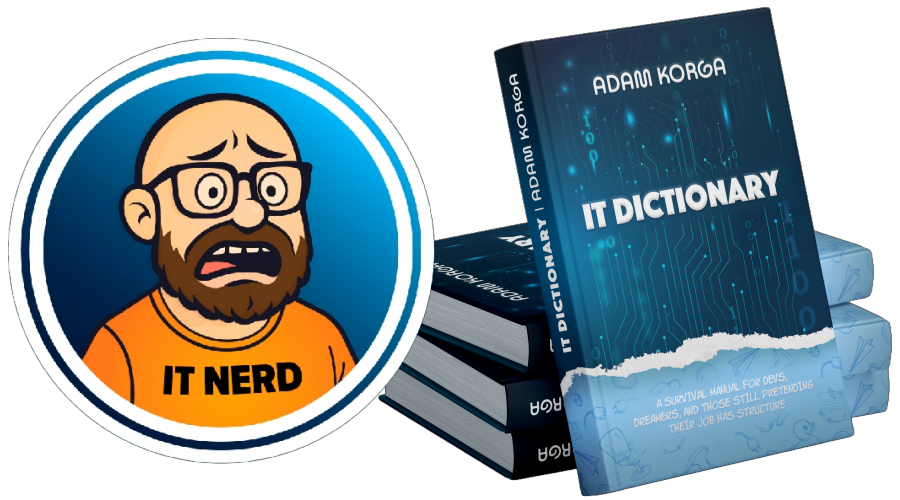
If someone had told me at the beginning of 2025 that I would seriously sit down and start writing a book, my first reaction would have been concern — not excitement. Mostly about their mental health. Possibly also mine.
Writing was never part of the plan. At best, it was something other people did. Preferably people with tweed jackets, a daily writing routine, and far fewer open browser tabs.
Origin — How a Joke Escalated
Like most things in IT, this didn’t start as a grand vision, a roadmap, or a five‑year strategy. It started as a joke.
At the time, I was seeing someone who worked in legal at a fairly large IT company. Different worlds, overlapping realities. Over coffee and after‑work conversations, I kept catching myself explaining the same phrases again and again — the strange jargon, the euphemisms, the inside jokes engineers use to describe reality without saying it out loud.
One day I thought it would be funny to turn that into a small gift: a tiny “dictionary” translating IT speak into plain human language. A few definitions. A private joke. Something you skim through, laugh at, and forget.
That was the plan. A very optimistic plan, as it turned out.
Except the list didn’t stop growing.
What started as a couple of pages quickly turned into a dozen. Each new term reminded me of three more. Every attempt to “wrap it up” failed spectacularly. The more I wrote, the more obvious it became that this wasn’t just about punchlines — it was about patterns.
Evolution — From Notes to Structure
The moment I touched Agile, the floodgates opened. In hindsight, this should have counted as a warning sign.
Suddenly there were rituals, roles, ceremonies, metrics, and belief systems begging to be translated. And once Agile was on the table, it became obvious that the same kind of linguistic gymnastics existed elsewhere too: in corporate structures, in startups, in management culture, in the way people talk about work versus how work actually gets done.
At some point, the relationship ended. The joke gift lost its original recipient. But the notes stayed.
And that’s when I realized something uncomfortable: I wasn’t done.
I kept adding entries — not because I needed more jokes, but because there were still things I wanted to articulate. The “dictionary” stopped being a prop and started becoming a lens — a way of describing the everyday absurdities of an industry I had been part of for years.
For a while, I did what felt easiest: I just kept adding more. More sections. More categories. More translations. Eventually I had to admit a hard truth — there was far too much material for a single, tidy project. So I started parking ideas “for later,” knowing full well that later probably meant another book. (Yeah, I have a file with enough material for almost entire “IT Dictionary 2.0 - One More Thing…“)
The real work began when I stopped expanding and started organizing.
What It Is — A Meta‑Dictionary of the Industry
Once I stepped back and looked at the growing list, a pattern emerged. Those ironic definitions weren’t random. Together, they painted a surprisingly coherent picture of the industry — its incentives, its blind spots, its rituals, and its coping mechanisms.
Instead of a flat list of jokes, I began grouping them into domains:
- Core IT concepts
- Agile and process culture
- Corporate life
- Startup mythology
- And finally, the unquestionable hit of 2025: AI
Each of these areas came with its own flavor of absurdity. Agile wasn’t broken in the same way corporate strategy was. Startup chaos didn’t look like enterprise inertia. AI hype followed its own unique logic, somewhere between religion and performance art.
Treating all of that with the same tone felt wrong.
So I did something I hadn’t planned on doing at all: I started writing prose. This is usually the point where things stop being reversible.
Each part was given its own distinct voice. Within that frame, every section opened with an introduction aligned to the convention of its part — mock‑legal language where it fit, religious or quasi‑biblical tones where faith and ritual dominated, bureaucratic decrees and compliance speak where process took over. Style became a tool — not decoration — deliberately chosen to expose the mechanics behind the language.
The result is the IT Dictionary: a satirical glossary on the surface, and a meta‑commentary underneath.
For people outside the industry — or just entering it — it works as a decoder ring. It explains why meetings feel the way they do, why processes multiply, and why the words people use often seem disconnected from reality.
For those already inside, the reaction tends to be recognition. Relief. Sometimes catharsis. The quiet reassurance that no, you’re not imagining things — and no, you’re not the only one noticing the contradictions.
Preparing the Ground — Learning to Publish
Writing the book was only half the problem. The other half was learning an entirely new discipline: publishing. A process best described as “discovering new ways to be wrong.”
Editing. Formatting. Distribution. Promotion. Suddenly I was dealing with things I had never planned to care about — and discovering that each of them had its own hidden complexity.
As part of preparing promotion, I started looking for ways to talk about the book publicly without just repeating the same jokes. That’s when another idea appeared — almost accidentally, just like the first one.
I began drafting short write-ups of major industry failures. Famous outages. Broken systems. Catastrophes everyone vaguely remembered but rarely examined closely. Initially, this was meant to be a small side project — a few LinkedIn posts, maybe a newsletter series.
Predictably, it didn’t stay small. The stories connected. The patterns became impossible to ignore. Before long, I found myself staring at another project that had outgrown its original container — but that’s a story for another time.
Reception — The Unexpected Reality Check
Before the book was finished, I shared early drafts with a small group of friends and trusted peers. People from different corners of the industry. The reaction was immediate and, to my surprise, remarkably consistent.
They didn’t just laugh. Which, for a satire, is both reassuring and mildly terrifying. They recognized themselves.
That early feedback mattered more than I expected. It was the first moment I seriously considered that this might be more than a private experiment — that there was something genuinely valuable hiding underneath the satire.
Encouraged by that response, I decided to take the next step and submit the book for professional review. That decision turned out to be a turning point.
Kirkus Reviews awarded the book their “GET IT” distinction. Independent Book Review went even further — granting it a Starred Review and including my debut “work” (and yes, I still use that word with a smile) on their list of the Best Books They Read in 2025.
To say that this exceeded my expectations would be an understatement.
Reader feedback reinforced the same pattern. Ratings on Amazon and Goodreads landed at 5.0 and 4.85 respectively — numbers that someone whose writing background previously consisted mostly of emails, documentation, and source code would never have dared to predict.
Those reactions didn’t just validate the book. They validated the idea that honest, satirical reflection on our industry has an audience — and that sometimes, saying the quiet part out loud is exactly what people are waiting for.
What matters most, though, is this: IT Dictionary wasn’t born out of ambition. It came from curiosity, irritation, and the urge to translate nonsense into something intelligible. The fact that it became a book was a consequence, not a goal.
If there’s one line that captures the spirit behind it, it’s this:
The industry doesn’t lack intelligence. It lacks honesty in the language it uses to describe itself.
Everything else followed naturally.