

Tools, repos, and other private chaos.
The Toolbox
This page documents a small set of tools I built along the way while writing books, publishing content, and trying not to lose my mind across too many channels.
If you came here looking for a curated list of "Top 10 Productivity Apps" or typical industry-standard SaaS recommendations, you’ll be disappointed. I use those too, but this page isn't about them.
This is a collection of single-purpose scripts built to solve specific problems. Because sometimes, writing 50 lines of dirty code is infinitely better than bending your workflow to fit a tool that requires a certification just to operate.
None of these tools were planned upfront. They appeared when spreadsheets stopped scaling, memory stopped working, or manual work got annoying enough to automate.
If you’re looking for a polished product — this isn’t it.
If you’re curious how things actually got done — welcome.
⚠️ License & Warranty
All tools are shared under the BookWare License. They work on my machine. If they blow up half your system — let me know. I'm not saying I'll fix it, but I might get a good blog post out of it. 😉
Think of this as my personal SaaT (Scripting as a Tooling) project. Because apparently no GitHub profile can exist without at least one buzzword. And I refused to use "AI-powered" for fancy regex parser.
Stat Counter
Balancing a book before it balances you
As I approached the finish line of writing the IT Dictionary, I decided the whole thing needed to be balanced (as all things should be). I whipped up a simple script to parse the manuscript export (Google Docs → HTML) and calculate basic stats: entry counts per section, introduction lengths, and so on.
Fun fact: It is not a coincidence that the introductions in Part 5 (dedicated to AI) are about 30% longer than the others. When the subject matter is verbose by design, the commentary should probably play along. Let's call it... stylistic alignment.
Sticks Generator
From spreadsheet to wall-sized reality check
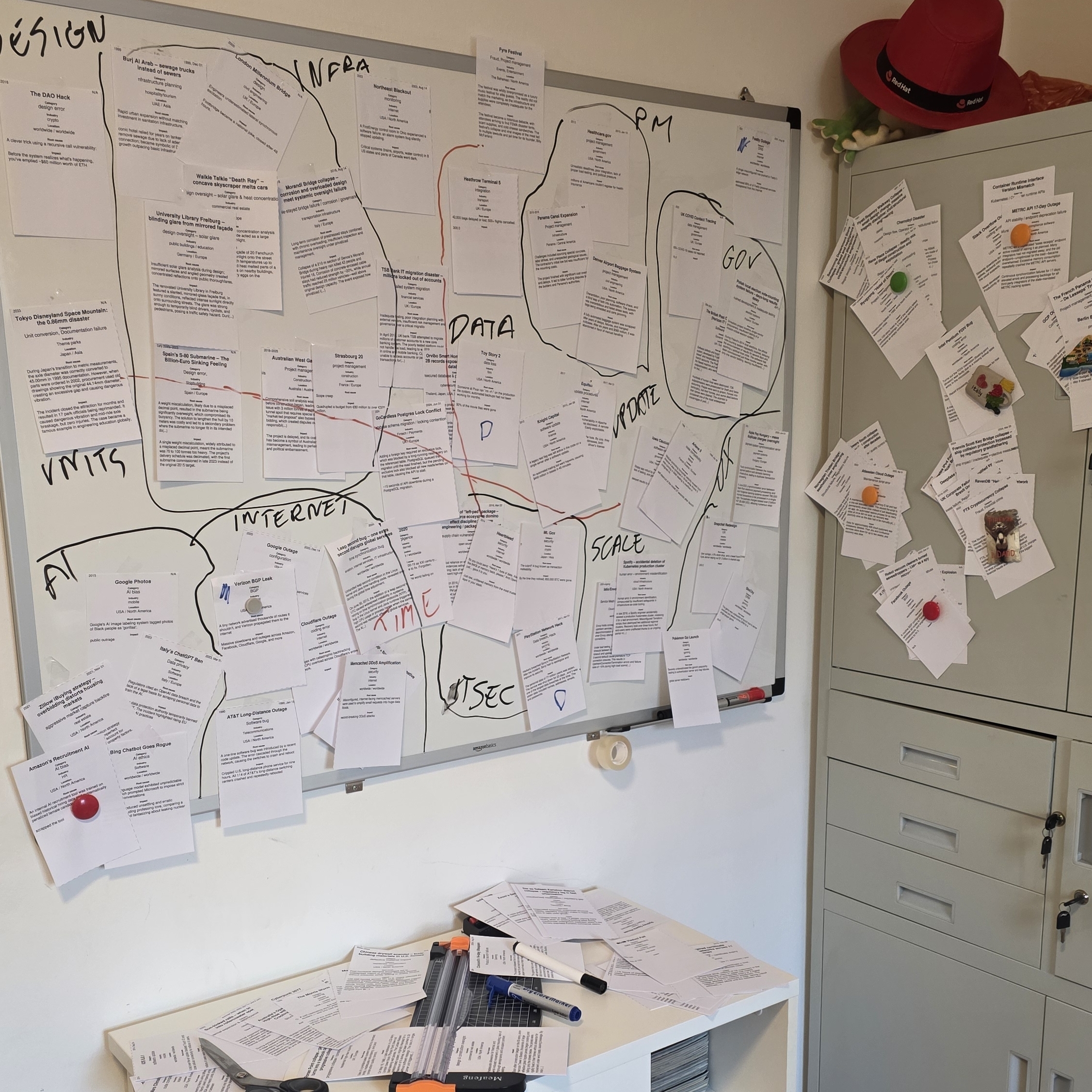
Researching and planning the Fuckup Almanac was a massive undertaking. At one point, I created a spreadsheet (anyone who's worked in a corpo knows that the spreadsheet is the ultimate issue tracker) with a master list of cases to cover.
Then came the grouping and structuring phase. I wrote a small tool to convert that spreadsheet into a PDF containing 4 "case cards" per A4 page. Then: print, cut, and enjoy a joyful afternoon in front of a whiteboard.
Call me old school, but I don’t shy away from analog solutions. Digital, physical—it doesn’t matter. They are just tools. They are supposed to serve me and the task at hand, not the other way around. I refuse to adjust my goals just to claim I did it "fully digital," "AI-driven," "AI-free," or whatever approach the latest trend deems fashionable.
🕵️ Spot the difference: Theory vs. Reality
How I remember it:

How it looked:
Queue Exporters
Because I can’t remember what I posted last quarter
It turns out that in this day and age, writing a book isn't enough. You also have to be "present online." So, I use a few tools to regularly publish content across different channels. If anyone asks:
- Buffer queues my LinkedIn posts.
- Aweber handles newsletter email queuing.
- This Blog has a simple mechanism for publishing posts by date. Astro (as an SSG) rebuilds the site every night using a mix of GitHub Actions, cron expressions, and CloudFlare Page builds. The repo is in the same profile, but it's private to avoid spoiling future posts.
The sheer number of channels makes it hard to keep track of where and what I've complained about. Besides... I don't remember what I had for lunch yesterday, so don't expect me to remember what I ranted about 3 months ago.
To solve this, I built a set of simple data exporters for backup and analysis (and yes, I sometimes feed this into an LLM to see if I'm repeating myself).