· Behind the Scenes · 5 min read
From Facepalms to Foundations: How the Fuckup Almanac Was Born
They say success is a lousy teacher, but failure? Failure is a goldmine. What started as a few LinkedIn posts quickly escalated into a 500-page exploration of digital chaos.

They say success is a lousy teacher, but failure? Failure is a goldmine.
It all started after I finished the manuscript for The IT Dictionary. I expected to feel a sense of relief, a “mission accomplished” vibe that would lead to a long vacation. Instead, something in my brain just… unlocked. The writing bug hadn’t just bitten me; it had moved in, started a family, and was now demanding a sequel.
But I wasn’t ready for another “dictionary.” I wanted to do something for social media—a series of bite-sized posts about IT blunders to keep this blog and my social channels alive.
Then I started the research.
The Afternoon of Sixty Facepalms
I sat down one Tuesday afternoon thinking I’d find maybe ten or twelve interesting stories to last me a month of LinkedIn updates. By dinner time, I was staring at a list of over sixty distinct, documented disasters. My head was in my hands.
Most of these stories I already knew—at least in passing—but seeing them all in one place changed the perspective entirely. It wasn’t just a list of “oopsies”; it was a catalog of systemic fragility. I realized right then that these stories were far too good to be buried in the algorithmic graveyard of social media. They deserved a spine. They deserved a book.
The Nerd Logic
As the list grew to over 150 cases, the “Disaster Porn” aspect started to feel a bit shallow. Sure, reading about a multi-million dollar satellite crashing because someone mixed up metric and imperial units is entertaining, but who would actually read 500 pages of just that?
I needed a system. Being a typical nerd, I didn’t just organize them; I built a custom tool to analyze the data (you can see my toolbox here). I started seeing patterns. These weren’t random errors; they were symptoms of how we build (and break) technology.
The big question was: Who is this for? My ambitions had outgrown the “specialist” circle. I wanted to explain to my neighbor why Facebook disappeared because of a BGP configuration error, or why Windows Mobile phones started receiving text messages from the future, without making his eyes glaze over.
The solution? Explainers. I decided to use the fuckups as a hook to explain how the technology is supposed to work. We look at how it breaks to understand the mechanism of the machine.
The “Antelope-Killer” Realization
Initially, I thought I was writing one big book. I was wrong. Somewhere around the sixth chapter, I realized I was writing an “antelope-killer”—one of those massive tomes that could double as a blunt-force weapon. It was too much.
I had to return to the whiteboard. I looked at the mountain of text and made an executive decision: this is a four-volume series. Each volume would focus on a specific domain. Volume 1 would be the Foundations.
By clearing out the content for future volumes, I suddenly had the space to breathe. I went back to the plan for Volume 1 and settled on five core pillars:
- Compute: The math, the time-keeping, and the scale of calculations.
- Internet & Networking: How computers talk (and how they ghost each other).
- Storage: How they remember things (and how they “forget” them during upgrades).
- Security: Because in the modern world, security is no longer an “optional” feature.
- Resiliency: How to build something reliable using inherently unreliable parts.
The Result: 500 Pages of Documented Chaos
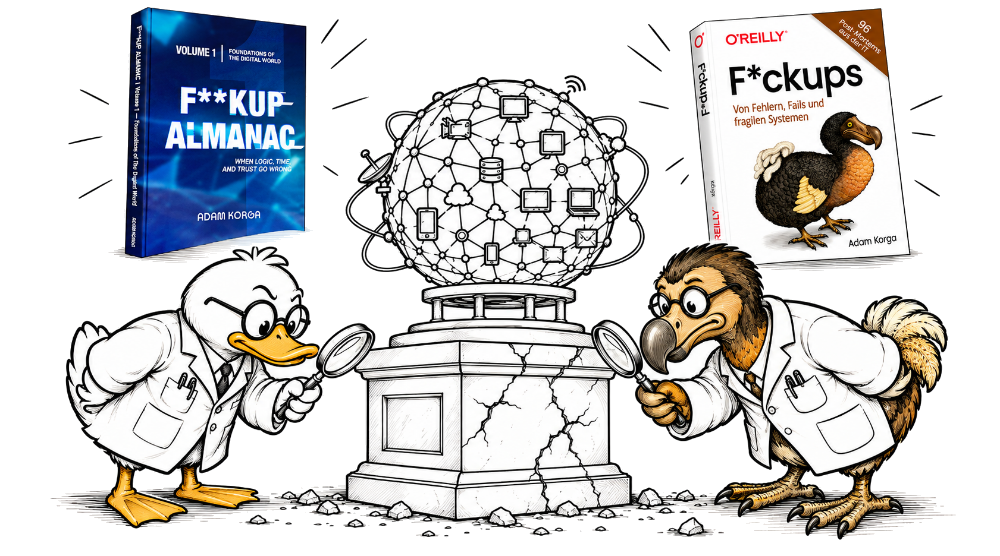
So here we are. Volume 1 is nearly 500 pages long, containing almost 100 true stories (no matter how unbelievable they sound) and 27 detailed explainers. It’s a map of the digital world’s basement:
- For the outsiders: It’s a guide to understanding what the nerds in flannel shirts are actually arguing about.
- For the students/juniors: It’s a friendly introduction that avoids academic fluff in favor of “here is what actually happens when you push that button.”
- For the veterans: It’s a “misery loves company” compilation that serves as a reminder of what to watch out for.
I’ve backed everything up with rigorous research. If you don’t believe a specific story is true, you can check the sources online.
Does it actually work?
Before going to print, I ran the draft through a gauntlet of readers. My 14-year-old nephew read it, as did CS students and corporate juniors looking for a reality check before their first “on-call” shift. I even shared it with people from completely different industries who were just curious about how the digital world (doesn’t) work, as well as Principal Engineers at global tech giants and university professors.
To my genuine surprise (and immense relief), they all found it engaging—albeit for very different reasons.
Of course, you could say they’re just being nice because they know me. Fair enough. That’s why I sent it to Independent Book Review and Kirkus Reviews. I paid for the service, but I had zero control over the verdict. I’ve seen the early reviews, and while I can’t share them just yet, let’s just say I won’t have to burn this pseudonym and start over on a remote island.
It turns out, everyone loves a good disaster—as long as they can learn how to avoid being the next one.