· Management · 4 min read
Corporate Schizophrenia: When Agile Meets the Budget
Software is discovery, not construction. But finance operates on a different religion: Predictability. Here is why your 'Agile Transformation' is probably theater.
If you spend enough time inside large organizations, you start to notice a recurring friction. It’s not the friction of bad coffee or slow elevators. It’s a deep, structural grinding of gears that happens every time the Engineering department tries to talk to the Finance department.
On one side of the glass, we have the Agile movement. It’s built on the realization that software is discovery, not construction. We acknowledge that we don’t know exactly what the user wants yet, that the market will shift, and that the best way to manage risk is through small, iterative steps. “Embrace uncertainty” is the mantra.
On the other side, we have Finance. Finance operates on a different, much older religion: Predictability. They need quarterly projections, annual budgets, and fixed KPIs. Their job is to minimize variance and ensure that when the company spends $2M, it gets exactly $2M worth of whatever was promised in the planning document twelve months ago.
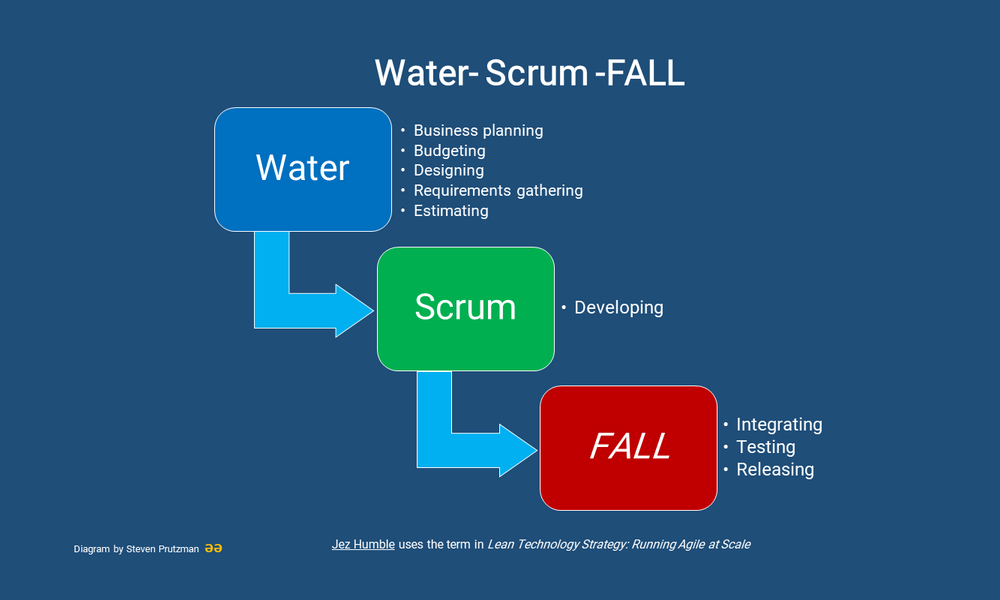
This is the Corporate Schizophrenia. We are trying to run a “discovery-based” process (Agile) inside a “prediction-based” infrastructure (Waterfall Budgeting). This eternal conflict is sometimes aptly called “water-scrum-fall”—a hybrid monster where analysis is waterfall, development is scrum, and deployment is waterfall again.
The Language Barrier
Beyond the structural mismatch, there is a fundamental language gap. Finance speaks the language of “Capitalized Labor,” “Fixed Assets,” and “Amortization.” Engineering counters with “Refactoring,” “Velocity,” and “Pivoting.”
It’s like trying to negotiate a trade treaty between two tribes that don’t share a single common noun. I’ve spent a significant portion of my IT Dictionary — specifically Part 2 (Agile Rituals) and Part 3 (Corpoland) — trying to translate these dialects of absurdity. But in the heat of a quarterly planning session, even the most accurate dictionary fails when one side is looking for a guarantee and the other is offering a probability.
The Ceremonial Lie
Because these two systems are fundamentally incompatible, organizations develop rituals to bridge the gap. We don’t solve the conflict; we just hide it behind a layer of creative documentation.
Engineering teams are forced to commit to a “Roadmap” for the next 18 months (essentially a Waterfall plan) just so Finance can approve the budget. Then, the teams are told to “be Agile” while executing that fixed plan.
The result isn’t Agility. It’s a high-speed Waterfall with better fonts.
We track “Velocity” in Jira to please the Scrum Masters, but the only metric that Finance cares about is “Variance to Plan.” If the team “pivots” based on user feedback (which is what Agile is for), they are often punished for “scope creep” or failing to deliver on the original, now-irrelevant commitment.
The Cost of the Illusion
The real tragedy isn’t just the inefficiency; it’s the erosion of honesty.
When a system demands predictability in an unpredictable environment, people learn to lie to the system. Estimates get padded, “Discovery” becomes a pre-determined path, and Innovation is sacrificed at the altar of Compliance.
We spend thousands of hours in planning meetings not to make better products, but to make the spreadsheets look safe. We trade accuracy for “alignment,” knowing full well that by Q3, the reality on the ground will bear no resemblance to the Slide Deck approved in January.
Failure by Design
This isn’t a “people problem.” You can have the most brilliant engineers and the most reasonable CFOs, and they will still hit this wall. It is a failure by design.
Modern software development requires a funding model that mirrors its reality—one that funds teams and outcomes rather than fixed projects and features. Until we bridge the gap between how we build software and how we pay for it, “Agile Transformation” will remain exactly what it is for most companies: a very expensive form of theater.
Success is often luck. Failure is always data. And right now, the data suggests that our budget cycles are the greatest bottleneck in technical innovation.