· Management · 6 min read
The Efficiency Trap: Why AI Won’t Save You from Work
We were promised a 15-hour workweek and a paradise of leisure. Instead, we got "AI Brain Fry" and an infinite mountain of automated slop to verify. Here’s why making things efficient is the worst thing to happen to your free time since the invention of the CC button.

Common sense is a beautiful thing. It tells us that if we make a process more efficient, we’ll use less of whatever goes into it. If a car uses half the fuel, we’ll save gas. If a machine does the work of ten men, those ten men can finally go fishing. If AI writes our code, we’ll be working four-hour weeks by Tuesday.
It’s a lovely theory. It’s also spectacularly wrong.
Welcome to the Jevons Paradox. In 1865, William Stanley Jevons observed that as the steam engine became more efficient at burning coal, coal consumption didn’t go down—it skyrocketed. Why? Because when something becomes cheaper and more efficient, we don’t just “save” it; we find a million new, previously “unfeasible” ways to use it until we’re consuming more than ever before.
And if you think IT is the exception, you haven’t been paying attention.
A Brief History of “Solving” Problems
History is littered with the corpses of technologies that were supposed to “reduce demand.”
- The Industrial Revolution: The Luddites weren’t just angry about machines; they were terrified of obsolescence. Instead, automation lowered the cost of goods, global demand exploded, and we ended up needing more specialists to manage the machines that were supposed to replace them.
- The Steam Engine: By making transport cheaper, it didn’t mean people traveled the same amount for less money. It meant we invented globalization. Suddenly, shipping a crate of tea across the ocean was “worth it,” and the demand for transport went vertical.
- The Computer: Remember the “Paperless Office” (I don’t, I’m not that old)? Computers were supposed to kill bureaucracy. Instead, they made it possible to generate 50-page reports, real-time analytics, and pivot tables for things that used to require a simple “yes” or “no.” We didn’t eliminate paperwork; we just digitized the forest and called it a “Data Lake.”
- Email: The ultimate “communication simplifier.” When sending a message became free, we didn’t communicate better; we just started CC’ing the entire department to “Cover Our Ass” (CYA). Decisions that used to be a quick chat at the coffee machine are now 40-thread email chains that will haunt your inbox until the heat death of the universe.
It’s worth noting that this isn’t the first time we’ve fallen for the promise of leisure. By the end of the 19th century, in the so-called “post-industrial revolution era,” economists were already dreaming of a work-free future. This eventually led to the famous Keynesian Prediction: in 1930, John Maynard Keynes famously argued that rapid productivity growth and technological advancement would solve humanity’s “economic problem” of scarcity. He forecasted a “paradise of leisure” where technological advancements would allow a 15-hour workweek, enabling people to focus on leisure rather than survival.
Well, 2030 is right around the corner, and we all know how that’s looking… unless a total reset happens in the next three or four years. Somehow, I highly doubt it. Instead, we’ve mostly used that extra time to invent Slack, JIRA, and LinkedIn.
The 2025 Reality Check: AI and the “Brain Fry”
As the saying goes, history has a habit of repeating itself. And right now, we are witnessing another textbook example of this exact phenomenon.
In 2024 and early 2025, the IT world was paralyzed by the vision of mass automation. Firms started layoffs, fearing that AI would make 80% of the workforce redundant. “The machines are coming for your Jira tickets!” they cried.
Well, it’s 2025, and the data is starting to tell a much funnier (and more exhausting) story. According to The SRE Report 2025 by Catchpoint, the amount of “toil”—that repetitive, soul-crushing manual work—actually increased for the first time in years, jumping from 25% to 30%.
Wait, what? With all these LLMs and “autonomous agents,” we’re doing more grunt work?
Yes. Because while finishing a task is easier than ever, our expectations have scaled even faster. Tasks that were deemed “too expensive” or “low priority” three years ago are now considered “essential” because they only take “five minutes of AI time.” The result? We’re drowning in “easy” tasks that, collectively, require a massive amount of cognitive effort to manage.
Scientists have already coined a term for it: AI Brain Fry. Your tools are faster, but your biological CPU is still running on the same 50,000-year-old firmware. We are context-switching at a rate that would crash a mainframe, all because we’ve made “doing stuff” so efficient that we’ve forgotten to ask if the “stuff” is actually worth doing.
On top of that, we’ve birthed an entirely new set of chores. Configuring agent swarms, managing “spec machines,” and other niche technical nonsense has become a full-time discipline we’re forced to master at breakneck speed. As per usual, we are building the plane after takeoff.
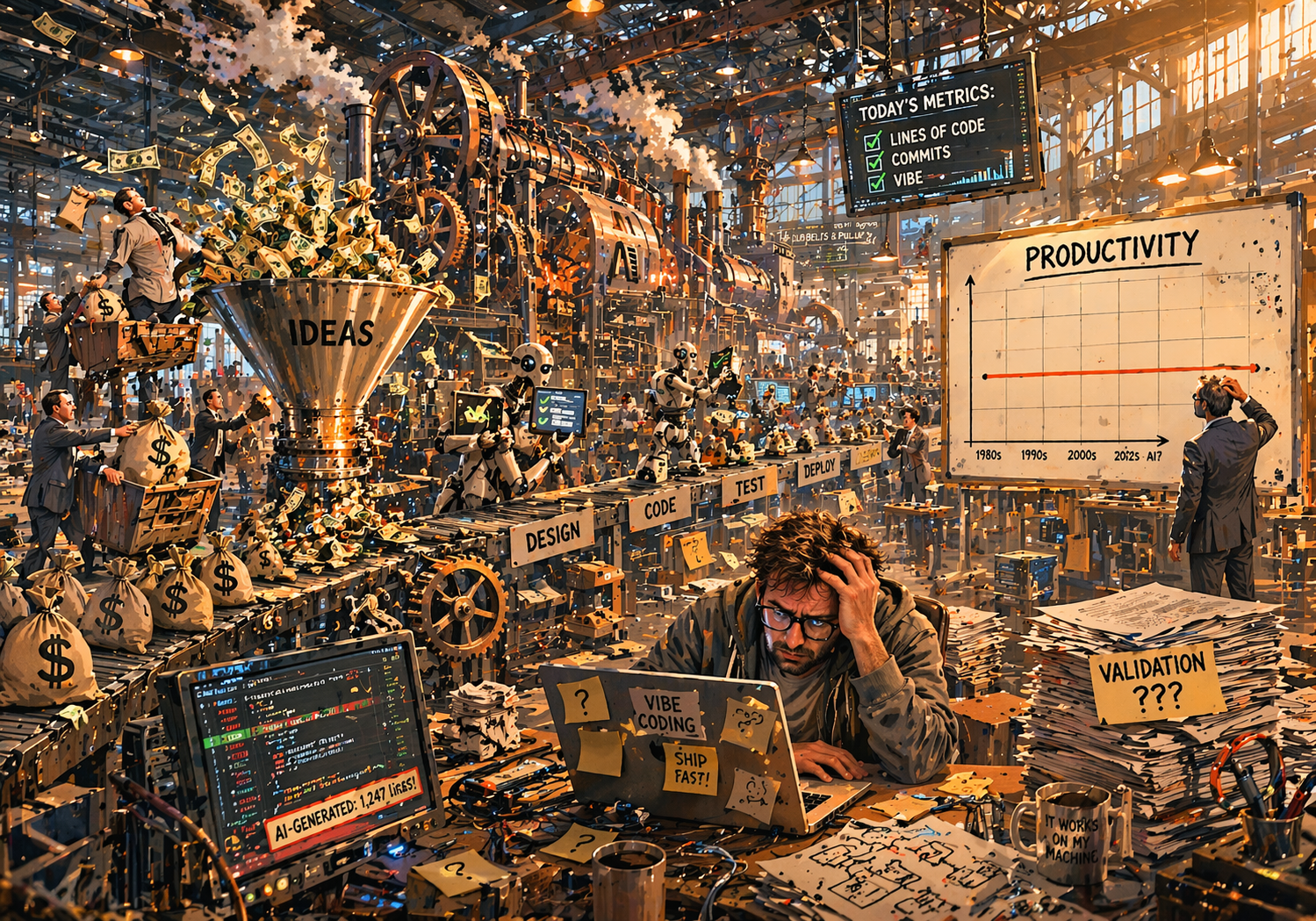
But it doesn’t stop there. One category of work has suddenly become the ultimate bottleneck: someone actually has to verify all this automated output. We’ve all heard the horror stories about hallucinations—whether it’s legal precedents that don’t exist, calls to library functions the creators never dreamed of, or sales reports straight out of Neverland. So sure, execution is easier. But verification is now non-negotiable. And if the machine churns out tasks in minutes, the mountain of “slop” you need to double-check only gets taller.
The work isn’t decreasing. It’s just changing shape.
The Good News (Sort Of)
So, here is the silver lining: Your job is safe.
We aren’t going to be replaced by machines; we’re just going to be buried under an infinite pile of AI-generated tasks that we still have to supervise, verify, and integrate. We’ve improved efficiency, so naturally, we’ve increased the workload. Jevons would be proud.
We are safe, for now… mostly. Because our brains haven’t quite realized they weren’t designed to process a thousand “automated” updates per hour.
This leads us to another fascinating economic glitch: the Productivity Paradox. It’s one of the strangest chapters in the history of technology—one where we spend trillions on tech and see zero growth in actual productivity. But that’s a rabbit hole for another time.
Until then, enjoy your AI-assisted efficiency. I’m sure you’ll find plenty of “extra time” to check those 300 unread emails.
4 sources
- Catchpoint Mehdi Daoudi 2025Accessed: 2026-03-10
- Harvard Business Review 2026Accessed: 2026-03-10
- ScienceDirect David A. Spencer 2025Accessed: 2026-03-10
- ScienceDirect John M. Polimeni 2005Accessed: 2026-03-10