· Engineering Culture · 8 min read
The Myth of the "10x Engineer" (And the Reality of the 0.1x Environment)
Companies spend hundreds of thousands of dollars searching for mythical 10x engineers, only to force them to work in a 0.1x environment. Why you don't need more heroes, but fewer roadblocks.
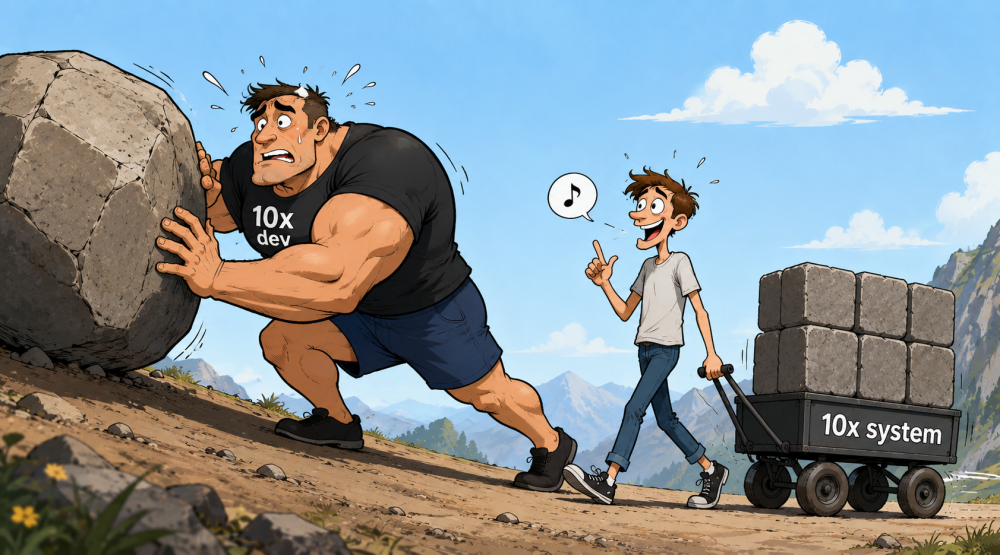
The tech industry is deeply, hopelessly in love with the myth of the “10x engineer.”
You know the character. The mythical, caffeine-fueled wizard who writes flawless code in their sleep, deploys to production using mind control, and single-handedly carries multi-million-dollar projects on their back.
Naturally, every modern tech company is currently on a tireless, desperate hunt for this unicorn.
The job description is always a masterpiece of corporate optimism. They aren’t just looking for someone to write a bit of React or fiddle with API endpoints. No, they want a legendary champion who will effortlessly architect the frontend, optimize the backend database, wrangle the Kubernetes cluster, set up comprehensive observability, and handle disaster recovery—all while casually answering customer support tickets during their lunch break.
And for extra credit? A deep, working knowledge of corporate accounting, basic first aid, and B2B marketing.
But here’s the best part: since this is still technically just one headcount, you shouldn’t expect a “10x salary.” Good heavens, no! Think of the equity. Think of the challenges. Think of the unlimited bananas in the kitchen and the “dynamic, fast-paced environment.” You should be grateful for the opportunity to save the company from its own architectural debt for the price of an average mid-level developer’s package.
Yet, there is a tiny, microscopic detail that these visionary employers seem to overlook. Even the most brilliant engineer on the planet does not write code in a vacuum. They operate within a framework. An environment. A system.
And usually, that system is a complete dumpster fire.
Step 1: Aligning with the “Culture”
Before our newly hired 10x ninja can even touch a line of code, they must first be baptized in the holy waters of corporate Culture.
Because, as we all know, a company isn’t just a collection of people trying to exchange labor for currency. It is a family. It has core values. And who better to define and enforce these values than an HR department completely severed from the physical constraints of reality?
To truly foster a “data-driven” and “innovative” mindset, HR will organize engaging initiatives. My personal favorite is the corporate AI Prompt Writing Contest. Nothing screams “we are a cutting-edge AI company” quite like forcing fifty disgruntled software engineers to spend an afternoon writing prompts to generate pictures of cats wearing business suits, all while the production database is slowly running out of memory.
Once you survive the prompt battle, it’s time for the All-Hands meeting. Or rather, the nested hierarchy of All-Hands meetings.
See, corporate physics dictate that alignment cannot happen just once. It must be layered, like a stale, bureaucratic lasagna.
First, you have the Global All-Hands, where the CEO passionately shares their grand 5-year vision of global market domination.
Then, because you obviously need a translation layer, you are dragged into the Tech All-Hands. This is where the CTO reveals the “AI-Revolution Strategy” that will soon automate 80% of your job (while simultaneously expecting you to work overtime to build it).
Just as you start heading back to your desk, you get a calendar invite for the Department All-Hands. Here, the VP of Engineering uses highly complex, colorful charts to prove that their specific department is single-handedly carrying the weight of the entire corporation.
The beautiful irony is that the lower you descend down the organizational food chain, the more frequent these “hands-on-deck” sessions become. By the time you reach your own tribe, chapter, and squad syncs, you are spending 20 hours a week watching slides presented by people whose primary skill is saying words like “synergy,” “velocity,” and “paradigm shift” without visibly laughing.
But wait, corporate alignment is a two-way street! To ensure your voice is heard, HR graciously schedules regular “Ask Me Anything” (AMA) sessions. Of course, “Anything” is defined here as “any question that has been pre-screened, heavily sanitized, and approved by a three-member moderation panel to ensure optimal positivity.” If you dare to submit a question about why the main staging environment has been down since Tuesday, it will mysteriously vanish from the Slido queue—only to be replaced by a pressing inquiry from an anonymous colleague asking how the executive leadership team manages to stay so incredibly inspired and energetic every single day.
You will walk out of these endless, cascading sessions deeply aligned, profoundly confused, and significantly closer to retirement.
Step 2: The Bureaucratic Gauntlet
Having successfully absorbed the culture, our 10x engineer is finally ready to build something. They open their IDE. They are ready to change the world.
But wait. Not so fast.
This is where the real fun begins, and where the industry’s obsession with “velocity” mysteriously vanishes into thin air.
Before a single line of code can be written, we must go through the sacred rituals of alignment. You can’t just fix a bug or add a button. You need to create a Jira ticket, write an RFC, an ADR, a POC, or some other KGB just to change a variable name.
And then come the meetings about the meetings:
- The Backlog Refinement (where we argue for 45 minutes about whether a task is a “3” or a “5” on a scale based on Fibonacci numbers).
- The Daily Standup (which is actually a sit-down micromanagement session).
- The Sprint Demo (where we show mockups of things that don’t work yet).
- The Customer Interviews (where we ask users what they want, ignore their answers, and build what the CEO saw on Twitter instead).
Once the code is finally written, it must pass through the gauntlet of automated gatekeeping.
Your pull request is blocked. Why? Because the SAST tool detected a high-priority security risk in a library you didn’t write. The DAST tool is unhappy. The test suite failed because of a flaky test written in 2019 by an intern who now works at Google. And, of course, your PR label is incorrect. It was supposed to be feature/highly-important-but-actually-useless, not feature/useless.
And whatever you do, do not—I repeat, do not—accidentally use tabs instead of spaces. The linter will find you. And it will show no mercy.
Step 3: The Magical Pivot
Let’s say our hero is resilient. They navigate the bureaucracy, survive the meetings, appease the linters, and realize that to build this feature properly, test it thoroughly, and ensure it won’t crash the billing system, they need about a month.
They lay out the plan. Management nods. “We trust you,” they say. “Take your time. Do it right.”
Two weeks—or sometimes two days—later, the management team has an epiphany.
“We need to pivot,” they announce.
Suddenly, all the priorities established during the grueling, soul-crushing three-day Quarterly Planning session are tossed directly into the shredder. The roadmap you spent weeks aligning on is now ancient history. The new priority is something entirely different, extremely rushed, and due by Friday.
The Reality: “Just Below the Line”
To be fair, I am not arguing that all processes, standards, or meetings are completely useless.
We live in a business reality. Synchronizing human beings is incredibly hard, and that synchronization has a cost. Coding standards, security validation, and architectural alignment are genuinely important if you don’t want your software to behave like a house of cards in a hurricane.
In fact, I am an opponent of removing all engineering friction. I’ve previously written a whole piece on why we should stop making things so damn easy, because some roadblocks are the only things keeping us from accidentally dropping the production database on a Friday afternoon. There is a healthy amount of friction that keeps us honest.
But there is a massive, yawning chasm between wearing a safety belt and being locked inside a bureaucratic iron maiden.
The problem is that in most organizations, all of this necessary scaffolding is “background noise.” It is friction. It is the tax you pay to operate at scale. It does not directly produce user value.
And because it doesn’t directly produce user value, investing in reducing this friction—improving developer tooling, speeding up CI/CD pipelines, simplifying deployment processes, removing redundant approvals—is always prioritized “just below the line.”
“We’ll fix the CI pipeline next sprint,” they say.
“We’ll automate the staging deployments next quarter,” they promise.
But “next quarter” never comes, because there is always another feature to ship, another pivot to execute, and another fire to put out.
The 0.1x Environment
Look, I’m obviously painting a highly exaggerated, cartoonish picture here. But this caricature serves a purpose: it highlights a very real, incredibly painful contrast at the heart of our industry.
Companies spend hundreds of thousands of dollars searching for mythical 10x engineers, only to force them to work in a 0.1x environment.
It is the equivalent of buying a Formula 1 racing car, putting it in the middle of a Friday afternoon traffic jam in Manhattan, and wondering why it isn’t setting any lap records.
An exceptional engineer cannot multiply a broken environment. When you drop a high-performer into a maze of slow builds, endless approvals, flaky environments, and shifting priorities, they do not magically transform the organization.
They just burn out. And then they update their LinkedIn profile to look for another company that promises a “dynamic environment.”
The best engineering organizations in the world don’t waste their time hunting for unicorns. They understand that talent is highly variable, but systems are leverage.
If you give an average, solid developer a system with fast feedback loops, clear ownership, instant deployments, and automated testing that actually works, they will quietly become surprisingly, shockingly effective.
You don’t need more heroes. You need fewer roadblocks.
Great engineers are nice to have. But great systems are what actually scale.
You’ll find more satire and bitter truths about the industry in the IT Dictionary.