

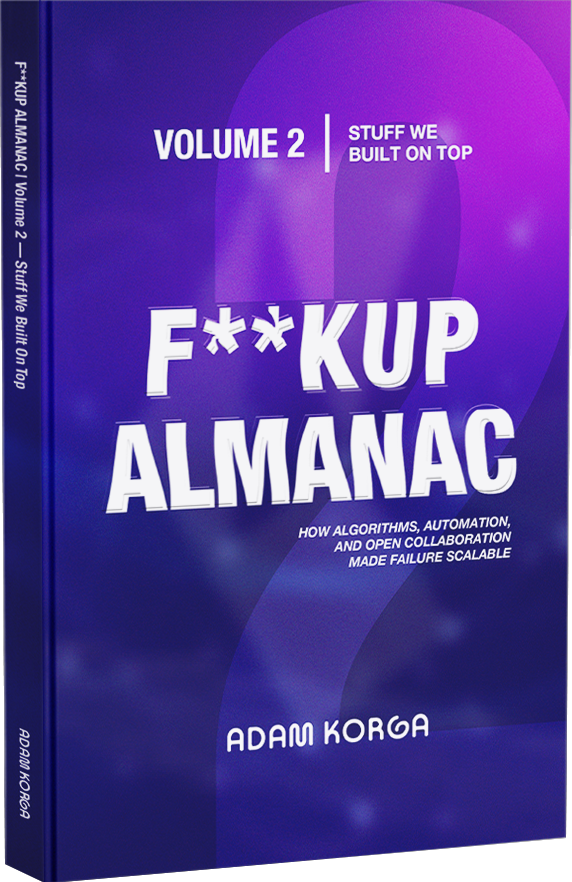
Vol 2: Stuff We Built on Top
A 14-year-old library maintained by a single developer quietly breaks on Sunday, and by Tuesday morning, three global banks can’t process credit cards. Meanwhile, a generative model writes a flawless legal brief, confidently citing six Supreme Court precedents that do not exist.
These are not isolated bugs. They are the inevitable outcomes of building a multi-trillion-dollar infrastructure on unchecked code and unearned trust.
Welcome to Fuckup Almanac Vol 2: Stuff We Built on Top.
In Volume 1, we crawled through the hidden foundations of computing: timezone protocols, floating-point math, networking, storage, and the rest of the digital plumbing nobody wants to think about.
Volume 2 moves up to the volatile software layers we eagerly piled on top of those foundations.
(And no, you don't need to read Volume 1 to jump straight in)
We start at the bottom with open-source supply chains and raw data collection. From there, we climb the ladder of abstraction through machine learning to generative AI—where engineering slowly starts looking less like mathematics and more like psychology.
This shift has a major side effect: software failures are rarely sudden, loud explosions. Instead, we deal with "Slow Rot"—a creeping decay of dependencies and quiet corporate efforts to sweep database corruption under the rug.
To bypass the polished PR, I reconstructed these failures using leaked Slack logs, court depositions, and forensic audits. This is still written by an engineer, but backed by 1,000+ verified sources that cannot be quietly deleted from a company blog.
Consequently, classic case studies sometimes yield to reflective, essay-style rants. Think of a drunk uncle who spent twenty years in the trenches—except this one brought a massive bibliography of memory dumps to back up his claims.
And while a software book in 2026 must cover AI, this is engineered to outlive the hysterical hype cycle. We focus instead on the unchanging math and human biases beneath the marketing magic.
This is an unfiltered audit for anyone who suspects our civilization is held together by digital chewing gum.
It has been successfully field-tested on everyone from teenagers to university professors.
None of them were permanently harmed in the making of this book. Temporarily unsettled, perhaps.
At a Glance
- 102 real-world failures, 38 system explainers, and 5 raw burn files from the trenches.
- Exposing the 'silent rot' and hidden dependencies swept under the corporate rug.
- Academic-grade rigor: connecting the dots across 1,000+ sources.
- Timeless engineering principles designed to last longer than a hype cycle.
- No hypotheticals—every single one of these spectacular collapses actually happened.
- The signature beer-talk tone, now upgraded with slightly more essayistic ramblings.
- Uncompromising respect where it's due, with a sober shift in tone for real tragedies.
- A structured narrative designed to gradually build system intuition.
- Still zero technical prerequisites—even Volume 1 is completely optional.
Table of Contents
Part VI: The Hollow Foundation - Supply Chains, Open Source, and the Illusion of Solidity
If civil engineers built bridges the way we build software, they’d walk down the street, grab some free steel left on the sidewalk by a stranger, and hope for the best. This is an audit of an industry coughing up dependencies—from the brittle chains of open-source libraries to cloud monopolies pretending to be the weather.
- Chapter 22: The Chain of Fools
- Chapter 23: The Trillion Dollar Volunteer
- Chapter 24: The Rug Pull — The Betrayal of Freemium
- Chapter 25: The Monoculture
- Chapter 26: Digital Feudalism – The Sovereign’s Prerogative in the Cloud
Part VII: Garbage Harvest — Data Collection Blunders
Before algorithms and AI can perform their digital magic, they first need to be fed. This part explores how we harvest those raw datasets—and how terribly wrong it can go. This is an audit of harvesting garbage—sorry, data—from flawed process design and spectacular technical failures during collection, to the desperate preparation phase where "cleaning" the results feels like wiping a window with wet mud.
- Chapter 27: Methodology - The Fine Art of Designing Failure
- Chapter 28: Technical Collection Screwups
- Chapter 29: The Data Was Fine Until We Touched It
Part VIII: Algorithms Gone Wild
We don’t need rogue AI to hallucinate our downfall when we can achieve authentic stupidity with "dumb," deterministic logic. This part looks at the steering wheel of technology—predictable code that goes wild in a messy world. It is an audit of Friday-afternoon scripts that follow instructions so faithfully they burn the house down to satisfy a metric.
- Chapter 30: Rules Gone Wrong
- Chapter 31: Feedback Loops – Amplifying the Absurd
- Chapter 32: When Optimization Becomes the Problem
Part IX: We Taught the Machine to Guess
We traded deterministic logic for statistical probability—the ultimate expression of human laziness disguised as mathematical genius. Long before generative bots, these predictive black boxes were already deciding credit risks and matching faces based on mere pattern-matching. We handed the steering wheel to systems that can see patterns in the asphalt but have no concept of what a "road" actually is.
- Chapter 33: Garbage In, Gospel Out
- Chapter 34: Models That Learned the Wrong Lesson
- Chapter 35: The Black Box Problem
- Chapter 36: When Models Meet Reality
Part X: Machines That Create
We transitioned from classifying reality to synthesizing it, wrapping the same systemic failures in a veneer of "creativity." Generative AI doesn't understand context—it is autocomplete on steroids, executing next-token prediction at an industrial scale. This is an audit of articulate parrots with an elephant’s memory and a 4chan moral compass, confidently hallucinating reality one token at a time..
- Chapter 37: Chatbots Unleash the Id
- Chapter 38: The Synthetic Tsunami
- Chapter 39: Reality Optional
- Chapter 40: Alignment Without Control
Part XI: The Human Interface
Finally, we return to the most volatile piece of the puzzle: the human element, and why the "human-in-the-loop" fail-safe so often backfires. The consequences of confusing the operator range from the completely absurd to the deeply tragic. This duality is baked right into the structure of this part: half of the chapters are facepalming comedies of error that defy belief, while the other half document sobering disasters that devastated real lives and entire communities.
- Chapter 41: The Human Interface Disasters
- Chapter 42: Bureaucracy Meets Code
- Chapter 43: The Human-in-the-Loop Paradox
- Chapter 44: The Illusion of Intelligence
Supplementary Materials
Chapter 0: The Anatomy of a Post-Mortem
The foundation of the entire Fuckup Almanac series—exploring why studying failures matters and how systematic analysis turns disasters into lessons.
Is it worth the read?
Start reading today
Choose your preferred format. All digital versions are DRM-free.
14-day money-back guarantee on all direct purchases (subject to Amazon return policy)