· Systems · 8 min read
The Myth of the Blank Page: Why We Fear AI for Doing Exactly What We Do
We are terrified that AI is blindly recombining data. But between Jung’s archetypes and Campbell’s monomyth, we might just be scared that it’s doing exactly what we do—only faster.
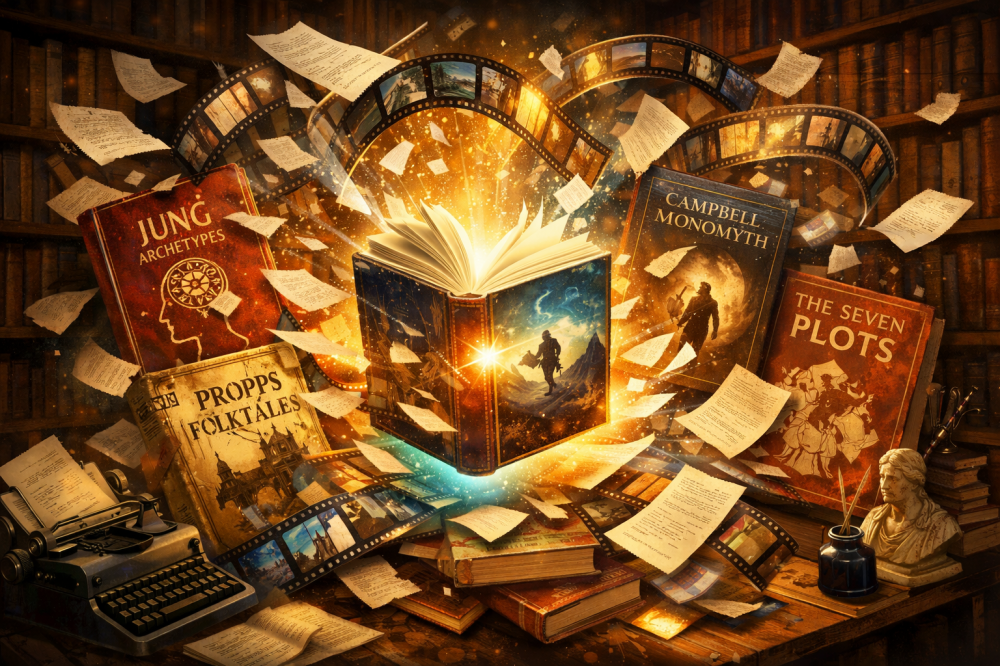
We are terrified that AI is copying us. But what if we’ve been copying each other for centuries?
Two weeks ago, while digging through the swamp of intellectual property and copyright protection, one legal case appeared: Feist Publications, Inc. v. Rural Telephone Service Co.
That ruling delivers a mildly sobering message. Catching someone copying your work is not enough. To qualify for protection, a work still has to cross a threshold of creative value. Facts — even carefully collected, booby‑trapped with clever tricks, or blatantly lifted — may still be legally fair game.
This is not just a phone‑book problem. It goes straight to the heart of today’s arguments about authorship, originality, and generative AI.
Before we go back to datasets, models, and training pipelines, we need a short detour. Not into technology, but into literature. Because if we can’t agree on what creativity means in a field we’ve been arguing about for centuries, we’re absolutely not going to solve it once machines join the chat.
Creativity Has a Shape (Sorry)
We love the romantic image of creativity: a blank page, a tortured genius, lightning striking at 2 a.m.
Unfortunately, psychology, literary theory, and comparative mythology have spent the last hundred years gently but firmly ruining that picture. What they show instead is creativity as a system with constraints, defaults, and reusable parts.
Not very poetic. Extremely inconvenient.
Jung: The Twelve Archetypes
Starting in the late 1910s and refined over decades, Carl Gustav Jung argued that storytelling pulls from a shared psychological basement called the collective unconscious. In it live recurring personality patterns — archetypes — that humans across cultures instantly recognize.
Modern narrative theory and marketing usually boil this down to twelve archetypes. One small footnote before the list: Jung himself proposed fewer. The Everyman was added later as a pragmatic extension, mostly by people whose job depends on selling stories.
Here’s the full set:
- The Hero
- The Rebel (Outlaw)
- The Sage
- The Caregiver
- The Explorer
- The Ruler
- The Magician
- The Innocent
- The Lover
- The Companion
- The Jester
- The Everyman
Most literary characters are not inventions. They’re configurations. Usually hybrids. Almost never something genuinely outside this menu.
Propp: Thirty-One Narrative Functions
Where Jung focused on who appears in stories, Vladimir Propp went after something far less romantic: what actually happens, step by step.
In Morphology of the Folktale (1928), Propp analyzed hundreds of Russian folk tales and came to an aggressively unpoetic conclusion. Regardless of surface details, they were built from the same small set of 31 narrative functions — atomic actions that always appear in a limited, repeatable order.
The exact list of these functions is long enough to derail the flow of this text, and to make matters worse it varies slightly depending on the translation from Russian. At that point, we would be halfway into a lecture on literary history — which is not the goal here.
What matters is the conclusion, not the inventory. Propp showed that stories are not just archetypal — they are procedural. Narrative can be decomposed into a finite sequence of reusable operations, executed in a predictable order. If you are curious about the full list, you will find it easily in the sources.
Campbell: The Monomyth as a Narrative Algorithm
If archetypes describe who shows up in a story, and Propp showed that stories can be decomposed into reusable narrative operations, Joseph Campbell focused on how those pieces are typically assembled.
Campbell’s work aligns perfectly with Jung’s archetypes and echoes the structural rigor found in Propp’s analysis, creating a higher-level narrative abstraction.
In The Hero with a Thousand Faces (1949), he mapped a structure so persistent it might as well be a flowchart. He called it the monomyth:
- Call to Adventure – something breaks the routine and demands a response.
- Crossing the Threshold – the protagonist leaves the safe, familiar world.
- Trials and Tests – things go wrong in educational ways.
- Encounter with the Mentor – wisdom is dispensed, often by someone who has seen some things.
- Crisis (Death and Rebirth) – the story’s emotional or literal breaking point.
- Reward or Revelation – knowledge, power, or insight unlocked.
- Return with the Elixir – coming back changed, hopefully useful.
Different costumes, same control flow. From ancient myths to blockbuster franchises.
Booker: Seven Narrative Templates
Christopher Booker took this idea and turned the compression knob all the way up. In The Seven Basic Plots (2004), he argued that global literature reduces to seven basic story shapes:
- Overcoming the Monster – a big threat must be dealt with (e.g., Beowulf, Star Wars: A New Hope).
- Rags to Riches – obscurity to success (e.g., Cinderella, Slumdog Millionaire).
- The Quest – go somewhere far, suffer productively (e.g., The Lord of the Rings, The Odyssey).
- Voyage and Return – strange world in, strange world out (e.g., Alice in Wonderland, The Matrix).
- Comedy – chaos slowly collapses into reconciliation (e.g., Shakespeare, repeatedly).
- Tragedy – downfall driven by a fatal flaw (hamartia) (e.g., Macbeth, Joker).
- Rebirth – moral or psychological reset (e.g., A Christmas Carol, Beauty and the Beast).
In this model, writers don’t invent plots. They choose one (or a few if they’re brave) and start tuning parameters.
Stacking the Constraints
Once you layer these models, creativity starts looking less mystical and more… engineered:
- Jung supplies the actors.
- Propp supplies a finite menu of allowed actions and narrative moves.
- Booker supplies the destination.
- Campbell supplies the path.
- Author’s lived experience supplies the texture.
With this stack, you can describe — and often predict — a disturbingly large portion of literature.
This doesn’t cheapen creative work. It explains why it works.
Bounded Imagination and the Horizon of Prediction
Human imagination, it turns out, is also rate‑limited. Science fiction makes this painfully obvious.
Writers almost never escape the technological grammar of their own era. Futures tend to look like the present, just louder.
Futurology calls this the predictability horizon — usually somewhere between 50 and 100 years.
History is full of receipts.
In his futuristic trilogy (including Le Vingtième Siècle, 1883), Albert Robida correctly anticipated mass communication, remote observation, and even proto‑video calls. His vision of future Paris — set roughly in the 1950s — is, however, buried under dense webs of telegraph, telephone, and power cables. This was not just a lack of imagination about wireless communication. At the time, even the idea of transmitting multiple independent streams of information over a single cable was severely limited. Without concepts like multiplexing or high‑capacity centralized links, scaling communication meant one thing: more wires. The result is a literal spiderweb of cables stretching across the sky.
Edward Bellamy, in Looking Backward: 2000–1887 (1888), described live music delivered straight into homes. Functionally correct. Implementation‑wise, it resembled a city‑wide hydraulic system of pipes and cables. Streaming, imagined as plumbing.
Arthur C. Clarke is often treated as the exception. In 1945, he described geostationary satellites before spaceflight was practical. But even here, the timeline behaves. Gagarin flew in 1961, the first geostationary satellite followed in 1964, and humans landed on the Moon in 1969. Clarke didn’t escape the horizon — he camped near its edge.
Even paradigm shifts rarely outrun imagination by more than a generation.
Creativity as Recombination
At this point, creativity starts to resemble evolutionary biology — and that resemblance is not accidental.
Humans are not a special exception in how novelty is produced. We like to think we are, but the underlying mechanism is boringly consistent across nature.
Evolution does not have access to brand‑new genetic material on demand. It works exclusively with whatever happens to be available at a given moment. It recombines, mutates, tests, and discards. Over and over again. Pure reuse and variation.
And yet, new species are formed.
No designer appears. No clean slate is introduced. Novelty emerges from recombination under constraint, filtered by selection.
Physics and chemistry tell a similar story, just on a larger timescale.
After the Big Bang, the universe had an almost comically limited toolkit: roughly 75% hydrogen, 25% helium, and trace amounts of lithium. That was it. Every other element we now consider fundamental — carbon, oxygen, iron, gold — came much later.
They were not added from the outside. They were produced through nuclear reactions inside the first generations of stars. From a tiny initial vocabulary, complexity emerged through recombination, pressure, and time.
Creativity follows the same rule. Human culture plays the same game.
The Uncomfortable Parallel
This is where generative AI enters the conversation.
The common complaint is that AI isn’t creative because it only recombines existing material. That’s true. It’s also a surprisingly accurate description of how humans work.
The real discomfort may not be technical. It may be personal. Recognizing similarity pokes a hole in the comforting idea that human creativity lives in a completely separate category.
Literature isn’t the only artistic field feeling this pressure — it’s just the one I drift toward most naturally, given that I clearly enjoy the sound of my own keyboard.
Next time, we’ll step away from text and take a quick look at visual art.
Analyzing the development of visual art makes one thing painfully clear: the current discourse is not new. What we now call an “algorithmic pipeline” or “processing model” existed long before mathematicians and IT specialists developed their fondness for impressive-sounding terminology.
Even the controversial idea of remixing existing works and motifs was debated, digested, and accepted in art long before we started teaching machines to do it for us.
But let’s not get ahead of ourselves.
Stay with me.
The Narrative Stack
The structural foundations of storytelling, from psychological archetypes to plot algorithms.
5 sources
The Narrative Stack
The structural foundations of storytelling, from psychological archetypes to plot algorithms.
- Jung, C. G. 1954Accessed: 2026-02-01
Collected Works Vol. 9 Part 1; the source code for the "actors" in our stories.
- Propp, V. 1928Accessed: 2026-02-01
English trans. 1958. The first rigorous attempt to decompose narrative into atomic functions.
- Scott Myers 2014Accessed: 2026-02-01
- The Hero with a Thousand FacesCampbell, J. 1949Accessed: 2026-02-01
The definitive manual on the Monomyth structure.
- The Seven Basic Plots: Why We Tell StoriesBooker, C. 2004Accessed: 2026-02-01
A massive study reducing all global literature to seven topological shapes.
Limits of Imagination & Legal Context
Historical evidence of the "predictability horizon" and the legal definition of creativity.
4 sources
Limits of Imagination & Legal Context
Historical evidence of the "predictability horizon" and the legal definition of creativity.
- Supreme Court of the United States 1991Accessed: 2026-02-01
499 U.S. 340. The ruling that established facts alone cannot be copyrighted without a "spark of creativity."
- Looking Backward: 2000–1887Bellamy, E. 1888Accessed: 2026-02-01
Famous for predicting "streaming" music via a system of hydraulic-style telephone cables.
- Le Vingtième Siècle (The Twentieth Century)Robida, A. 1883Accessed: 2026-02-01
A visionary work that predicted mass media but failed to foresee wireless transmission.
- Profiles of the FutureClarke, A. C. 1962Accessed: 2026-02-01
Contains Clarke’s Laws and his analysis of the "Hazards of Prophecy."