· Systems · 5 min read
The Productivity Paradox: Why Your New Shiny Toys Aren't Working (Yet)
Technology doesn't cause an explosion of productivity by itself. Unlocking the value requires a total system reboot.
The Productivity Paradox: Why Your New Shiny Toys Aren’t Working (Yet)
Let’s be honest: history is a broken record. We keep playing the same track, hoping for a different remix, but the lyrics never change. If you want to understand why your company’s latest “digital transformation” feels like burning money in a high-tech dumpster, don’t look at the future. Look at the past.
Welcome to the Productivity Paradox.
The 1980s: When the Stats Didn’t Care About Your Hardware
Back in 1987, Robert Solow—a guy with a Nobel Prize and zero patience for hype—dropped a line that still haunts CTOs: “You can see the computer age everywhere except in the productivity statistics.”
Think about it. The late 80s and early 90s were a tech-fueled fever dream. We had the rise of what I’d call the Four Horsemen of the Silicon Apocalypse: IBM, Microsoft, Intel, and Apple. Companies were throwing literal mountains of cash at hardware. Even the shooting stars of the era—Commodore and Amiga—were far more than the “gaming toys” people remember; they were the workhorses of early digital music, CGI, and professional office suites.
The tech was powerful, it was versatile, and it was everywhere. The expectation? A global productivity explosion. The reality? A flatline.
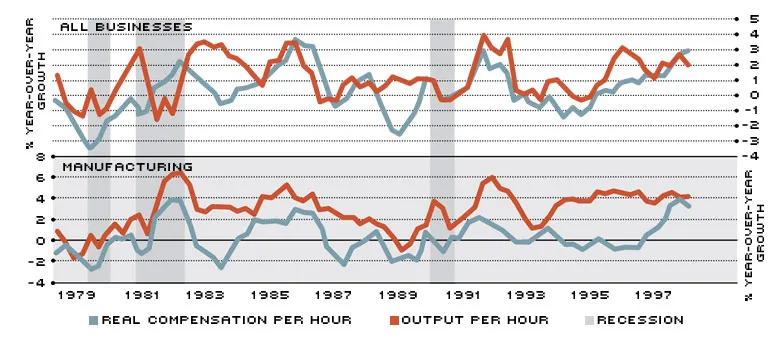
Just take a look at the chart above. During the exact period when industries were spending an absolute fortune on computerization, productivity—whether you measure it by “Output Per Hour” or “Real Compensation Per Hour”—was practically standing still. All that investment, and the needle on the economy’s dashboard barely quivered.
Now, economists have a dozen theories for this: measurement problems, redistribution, implementation costs… Look, I’m not an economist. Let’s focus on the one that actually explains why we keep failing: The Lag Hypothesis.
The Telegraph: Speculators 1, Real Economy 0
Go back to the mid-19th century. The telegraph arrives and suddenly, the “Information Age” is born. Arbitrage became the name of the game—knowing the price of grain in London seconds before the guy next to you was a license to print money.
But for the real economy—the people actually growing and moving stuff—the telegraph was a tease. You knew the price of your wheat had plummeted, but your cargo was still on a wooden ship powered by a prayer and some wind. The data world was lightning fast, but the physical world was a Victorian-era slug. Because the “real” world wasn’t in sync, the overall productivity didn’t budge.
The Electricity Trap: Why You Need to Redesign the Process
Between 1890 and 1920, we had the Electric Revolution. Entrepreneurs saw electric motors and thought, “Great, let’s ditch the steam engine!”
But they did it the lazy way. They took out one giant steam engine and replaced it with one giant electric motor, keeping the same messy system of belts and pulleys snaking through the factory. Productivity barely moved.
The boom only happened when they realized they had to rebuild the entire workflow from scratch. It wasn’t about the motor; it was about the floor plan. They had to scrap the old centralized layout and redesign the entire factory from the ground up, placing small motors at every individual workstation. You can’t just swap a component; you have to rethink the architecture of the work itself.
The Typewriter: Writing More, Not Better
Around the same time, offices got a new toy: the typewriter. Everyone expected faster communication. And we got it. But instead of saving time, we just started writing longer reports and creating more bureaucracy.
We didn’t become more productive; we just became more “busy.” In fact, it wasn’t until someone invented vertical filing cabinets and standardized forms that we actually managed to organize the mountain of paper we’d created. Interestingly, this exact flavor of the paradox repeated itself decades later with the introduction of email—something I’ve written about before in the context of the Jevons Paradox.
Fast Forward: The Dot-Com Disaster and Modern Meds
In the late 90s, we saw this again with the dot-com bubble. Investors assumed that having a website was a magic spell. It wasn’t. The “New Economy” stayed a rounding error until companies realized that a shiny URL was useless if your warehouse was still stuck in 1974.
The winners weren’t the ones with the best websites; they were the ones who completely overhauled their logistics and fulfillment to match digital speed. They realized that you can’t layer “new economy” speed on top of “old economy” friction.
Even today, look at Modern Healthcare. Hospitals generate petabytes of data, yet doctors spend more time clicking boxes in a shitty UI than looking at patients. Digital bureaucracy has actually lowered productivity because the system around the doctor hasn’t been rebuilt to handle the data.
The Moral of the Story
Every single time, the story is the same: Technology doesn’t cause an explosion of productivity by itself. You can’t just swap one block for another and expect magic.
Unlocking the value requires a total system reboot—rebuilding workflows, changing habits, and literally reimagining how you work. And let’s be real: rebuilding a system is much harder than signing a check for new hardware.
We are repeating this mistake right now with AI. We are buying the engines, but we are still using the old belts and pulleys.
But that’s a story for next time.
7 sources
- Solow, R. 1987Accessed: 2026-04-14
- Brynjolfsson, E. 1993Accessed: 2026-04-14
- David, P.A. 1990Accessed: 2026-04-14
- The Victorian InternetStandage, T. 1998
- Control Through Communication: The Rise of System in American ManagementYates, J. 1989
- Brynjolfsson, E. & Hitt, L. 2000Accessed: 2026-04-14
- Sinsky, C., et al. 2016Accessed: 2026-04-14