· Systems Thinking · 6 min read
The Tragedy of the Commons: How Rational People Systematically Destroy Everything Good
When everyone acts with perfect individual rationality, the shared pasture dies and every cow starves. Here is why the Tragedy of the Commons is hiding inside your cloud bill, your dependency tree, and your codebase—and what governance can actually do about it.
A few weeks ago, while dissecting the delightful absurdity of the Nash Equilibrium, I briefly mentioned a closely related systemic phenomenon: The Tragedy of the Commons. At the time, I promised this was a systemic rabbit hole we would explore “someday™.”
Well, congratulations. Today is “someday™.”
What’s in a Name? (Cows, Oxford, and Garrett Hardin)
The English term “Tragedy of the Commons” sounds almost abstract—like a Victorian theater play or a mild inconvenience in a public park. The core issue is somewhat obscured by the word “commons.”
Personally, I’ve always preferred the Polish name for this phenomenon—tragedia wspólnego pastwiska (literally “the tragedy of the shared pasture”). It cuts straight to the brutal, grass-nibbling heart of the matter as popularized by ecologist Garrett Hardin in his landmark 1968 essay published in Science magazine. (Side note: I’m referencing an open-access reprint hosted by UChicago, because paywalling foundational essays on shared knowledge would be a meta-tragedy in its own right.)
While Hardin popularized the concept in the 20th century, the underlying mechanics were discussed much earlier—for instance, by economist William Forster Lloyd in the first half of the 19th century.
So, what’s the setup?
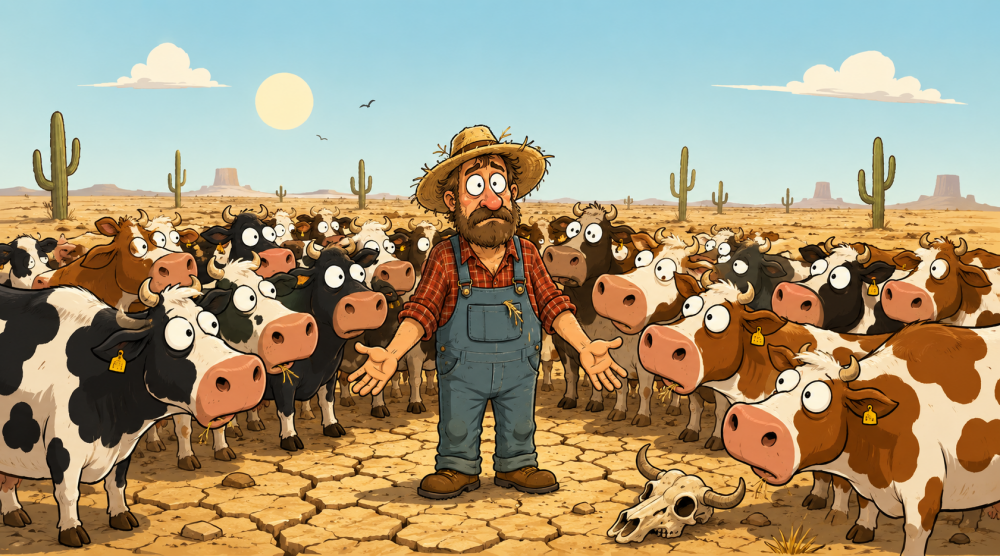
Imagine a lush, green, open pasture shared equally by a community of local farmers. Enter Farmer Bob. Bob looks at the pasture and performs a quick, totally rational calculation:
- Benefit: If I add one more cow to the pasture, I get 100% of the profit from that extra milk and meat.
- Cost: The extra cow eats grass, slightly overtaxing the pasture. But because the pasture is shared among all N farmers, the cost of that extra cow’s appetite is split equally. My share of the damage is only 1/N.
For Bob, the decision is a no-brainer: +1.0 benefit versus a fraction of the cost. Profit maximized!
The minor flaw in this brilliant economic maneuver? Every single farmer runs the exact same calculus simultaneously.
Everyone adds “just one extra cow.” The cows eat. The grass fails to regenerate. The soil turns to dust. The pasture dies, and every single cow starves. By acting with absolute individual rationality, the group achieves total collective devastation.
Welcome to the ultimate system failure mode.
Once You See It, You Can’t Unsee It
Once you tune your brain to recognize the systemic architecture of the Tragedy of the Commons, you realize human society is essentially a giant collection of overgrazed pastures.
Here are a few classic real-world flavors:
- Ecology & Plastics: “What difference does one plastic straw or shopping bag make? It’s just a tiny piece of trash.” Multiply that rational apathy by 8 billion people, and you get the Great Pacific Garbage Patch—a floating vortex of synthetic debris covering roughly 1.6 million km². To put that into perspective, it’s nearly three times the size of Texas (695k km²).
- Oceanic Overfishing: “If I pull a few extra fish out today, the ocean won’t run empty. It’s massive!” Says every commercial fishing enterprise on Earth. Result? Entire fish species harvested past the point of biological recovery, collapsing global stocks.
- Groundwater Depletion: “Leaving the tap running while I brush my teeth is just a drop in the bucket.” Sure, individually it is—though these days, your running faucet pales in comparison to the insane water consumption of Big Tech trying to keep data centers cool so AI can generate pictures of cats dressed as Napoleon.
- Traffic Jams: “Why should I suffer on public transit when I can drive my comfortable car? One extra car won’t cause a traffic jam.” Except when everyone makes the same self-interested choice, resulting in rush-hour gridlock where the average transit speed drops to a brisk, depressing walking pace.
The IT Ecosystem: The Ultimate Digital Pasture
Of course, I wouldn’t be writing this if the software industry wasn’t overflowing with its own high-tech pastures being devoured by metaphorical cows.
In IT, we love pretending we are hyper-logical engineers, yet we fall into this trap constantly:
1. The Open Source Parasite Economy
Virtually all modern enterprise software—the foundation of global finance, logistics, and tech—is built on top of open-source software. Companies race to build billion-dollar SaaS empires, treating open-source packages as free, infinite natural resources. Meanwhile, critical global infrastructure like curl or OpenSSL ends up being maintained by a grand total of two severely burnt-out engineers working in their spare time. (I actually dedicated an entire chapter to this exact systemic failure in Fuckup Almanac Vol. 2)
2. Cloud Infrastructure (The Unlimited AWS Buffet)
In a massive enterprise, an individual feature team feels zero accountability for the broader cloud bill. Need faster performance? Don’t optimize your O(n³) algorithm—just spin up another massive instance or drop in another managed database. “Our team’s extra $200/month doesn’t matter to a multi-billion dollar company!” Multiply that mindset across 150 engineering teams, and six months later the CFO is hyperventilating over a $4,000,000 monthly cloud invoice.
3. Technical Debt As an Unpriced Externality
“If I copy-paste this hack just to hit the sprint deadline, it won’t hurt anyone.” But when every developer on the team contributes their own “quick hack” to meet arbitrary quarterly targets, the codebase transforms into a terrifying, toxic eldritch horror. Six months later, nobody understands the system, touching a single line breaks production, and feature delivery grinds to a halt.
4. The AI Slop Avalanche
On the socio-technical frontier, we have the current explosion of AI-generated content. Every aspiring “thought leader” and hustle-bro generates low-effort, synthetic blog posts, LinkedIn essays, and SEO slop because “it only takes 5 seconds, so why not?” The cost to the individual is zero; the benefit (potential clicks) is nonzero. But what’s the systemic result? Honestly, don’t take my word for it—just open literally any social media platform or feed you have at hand, and watch as it chokes under a mountain of digital garbage.
In other words:
- Every individual creator benefits from publishing one more AI-generated article.
- Every platform benefits from serving one more page.
- Every LLM benefits from ingesting one more document.
- Nobody individually benefits from an Internet where signal is slowly drowned by synthetic noise.
Yet that’s exactly the equilibrium we’re collectively optimizing for.
How Do We Fix It? (Enter Governance)
Are we doomed to graze every meadow into a desert? Not necessarily.
Political economist Elinor Ostrom actually won a Nobel Prize for demonstrating that communities can manage common resources successfully without collapsing into ruin. The secret sauce?
- Clear boundary rules
- Mutual monitoring
- Graduated sanctions for rule-breakers
- Conflict resolution mechanisms
None of these mechanisms rely on people suddenly becoming altruistic. They simply change the incentive structure.
In tech terminology, we call this Governance. It’s the unglamorous work of setting up cloud budgets, enforcing code quality standards, contributing back to open-source dependencies, and establishing guardrails against systemic abuse.
The Cliffhanger: A Word of Warning
Before you run off to implement 47 layers of strict approval workflows, mandatory compliance checks, and bureaucratic gatekeeping to protect your digital pasture… beware.
Just as you can destroy a system through unchecked self-interest, you can easily paralyze it through over-regulation. When too many people hold the right to block the use of a shared resource, nobody can use it at all.
This delightfully perverse opposite phenomenon has a name: the Reverse Tragedy of the Commons (or the Tragedy of the Anticommons).
As it turns out, building fences around the pasture can become just as dangerous as having no fences at all… but that’s a story for another “someday™.”
The Tragedy of the Commons and Its Governance
Foundational and canonical texts on shared-resource depletion and the institutions that manage it.
3 sources
The Tragedy of the Commons and Its Governance
Foundational and canonical texts on shared-resource depletion and the institutions that manage it.
- Science / University of Chicago Garrett Hardin 1968Accessed: 2026-07-28
The landmark 1968 essay in Science that popularized the concept for the 20th century. Open-access reprint.
- Wikimedia Commons William Forster Lloyd 1833Accessed: 2026-07-28
The most frequently cited early source for the shared-pasture mechanics, delivered as Oxford lectures over a century before Hardin.
- Cambridge University Press Elinor Ostrom 1990Accessed: 2026-07-28
The 1990 work for which Ostrom won the 2009 Nobel Prize, demonstrating that communities can govern common-pool resources without collapsing into ruin.