· Systems Thinking · 4 min read
The World Rhymes: From Galaxies to Kubernetes
Whirlpools look like galaxies. Veins look like rivers. And crowd panic looks mathematically identical to boiling water. Why patterns repeat across systems and how noticing them makes you a better engineer.

Have you ever noticed how Wi-Fi always dies in the exact room where you need it most? Or how traffic jams behave suspiciously like denial-of-service attacks?
The weird truth is this: the world rhymes across systems.
Patterns repeat everywhere. Whether it’s your body, your city, or your cloud cluster, the same rules keep showing up. Once you start spotting them, you can’t unsee them.
The Universal Blueprint (Nature’s Lazy Design)
Let’s look at the physical world first.
Water whirlpools are surprisingly similar in shape to hurricanes. Zoom out far enough, and those hurricanes look eerily like spiral galaxies. Gravity, fluid dynamics, atmospheric pressure—these are different forces operating on vastly different scales. Yet, the resulting structure is almost identical.
It gets more specific.
Look at the human circulatory system. The branching structure of veins and arteries is optimized to transport fluid to every cell. It looks remarkably like the nervous system. You could argue that’s just biological evolution reusing a good idea. Fine.
But then look at the veins in a leaf. Then look at a satellite map of a river delta and its tributaries.
Biology, botany, and geology. Totally different domains, yet they all converged on the same branching fractal pattern to solve the problem of distribution.
The Hidden Code: Fractals and Constants
The story doesn’t end with obvious visual similarities.
Consider the jagged shape of a coastline and the crystalline structure of a snowflake. One is formed by the chaotic, erosive power of ocean waves; the other by precise thermodynamic processes of freezing water. They seem unrelated.
But mathematically? They are cousins. They are both fractals.
They follow the same underlying mathematical laws regarding self-similarity. The physical forces differ, but the logic governing them is the same.
Speaking of math—there’s a reason students around the world groan at the mention of (Pi) or (Euler’s number). Or consider (Phi, the Golden Ratio). We treat them as abstract concepts to memorize for exams, but they act like fixed points that keep reappearing whenever systems grow, oscillate, or stabilize. They show up everywhere—from the spiral of a nautilus shell to the oscillation of a bridge in the wind.
We Build What We Are
So, nature rhymes with itself. That’s poetic. But here is the interesting part: human-made systems rhyme with nature.
We like to think we invent new technologies, but often we just rediscover existing dynamics.
- Information Flow: The way data packets route around a failed node in a network is mathematically similar to how water flows around a rock in a stream.
- Crowd Dynamics: The behavior of a crowd during a panic can be modeled with almost the same equations used to describe phase transitions—like water turning into steam or hot metal losing its magnetism.
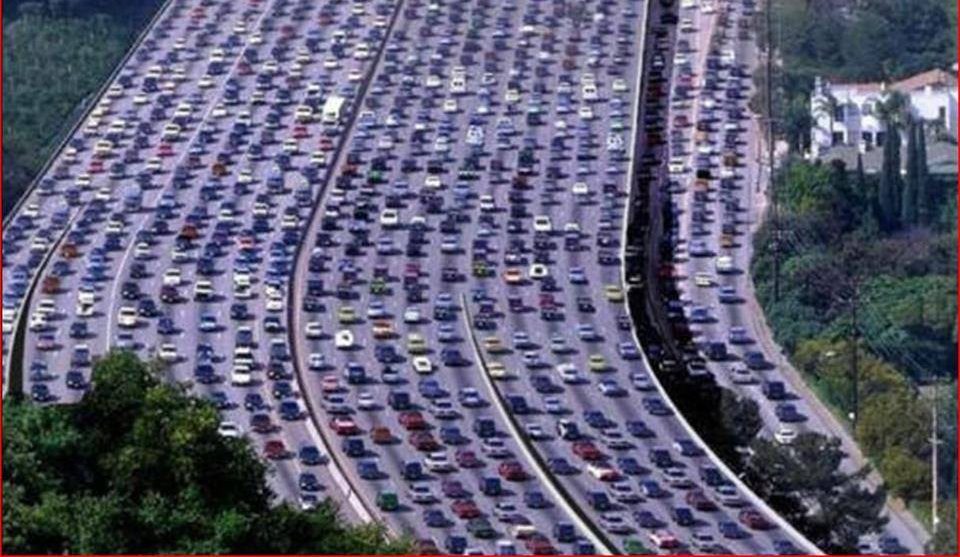
- Network Congestion: A traffic jam on a highway and a database write-lock create the exact same type of queue.
This isn’t just metaphor. A few weeks ago, I wrote about how Kubernetes is essentially a CIA spy network. HQ (Control Plane) decides the strategy, but the field agents (Nodes/Pods) have to execute locally and autonomously.
It’s the same architecture. Different substrate, same rules.
Why This Matters
These parallels aren’t just interesting trivia for a dinner party. They are the reason “linear fixes” so often fail in engineering.
If you understand that a traffic jam is a flow control problem, you understand why simply widening the road (adding bandwidth) rarely fixes it—induced demand fills the space immediately.
If you understand how an immune system identifies threats without a central “brain” checking every cell, you can design better distributed security systems.
The map won’t solve the problem for you, but it keeps you from walking straight into the same trap that nature—or another industry—solved a million years ago.
Systems thinking won’t give you the answer — but it dramatically reduces the number of stupid ones.
In fact, I might write a whole book to help you start seeing those patterns.
In the meantime, check out The Fuckup Almanac, where I use this exact trick to explain complex technical failures (and why we keep repeating them).