· Engineering Culture · 15 min read
Why Smart People Build Dumb Things: Nash Equilibrium and the Art of Stable Absurdity
The fundamental flaw in our design of societies, economies, and organizations is a simple, mathematical misunderstanding: we confuse stability with optimality.

We like to believe that human progress is a linear march toward efficiency. We tell ourselves that if we put enough intelligent, well-meaning people in a room, give them a shared objective, and pay them handsomely, the result will be a beautifully optimized, highly functional system.
It is a lovely theory. It is also entirely wrong.
The fundamental flaw in our design of societies, economies, and organizations is a simple, mathematical misunderstanding: we confuse stability with optimality. In reality, the most resilient systems are often the most profoundly inefficient. It is precisely because people act rationally, logically, and in their own best interests that they collectively construct monstrosities that no single individual would ever deliberately design.
And while this phenomenon shapes everything from global climate policy to city traffic, its absolute masterclass can be found in the modern corporation.
Welcome to the world of Nash Equilibria, where everyone plays their hand perfectly, and the house burns down anyway.
A Beautiful Mind Was Right (Mostly)
Let’s bypass the dense academic jargon and go straight to the pub.
If you have watched the 2001 film A Beautiful Mind, you probably remember the scene where Russell Crowe’s John Nash has an epiphany about game theory while observing a group of men trying to pick up women.
The setup is classic, if somewhat cringey through a modern lens: a group of friends in a bar see a group of women. Everyone wants to go for the “most attractive” woman in the room. Nash points out that if everyone follows their individual urge and competes for her, they will block each other. She will reject them all out of sheer fatigue, and when they try to pivot to her friends, those friends will reject them too, feeling like second-choice consolation prizes.
The logical move? Everyone ignores the “main target” and goes for the friends. That way, nobody gets blocked, and everyone leaves happy.
While the gender dynamics of this 25-year-old cinematic analogy feel undeniably dated and masculine-centric, the mathematical intuition remains flawless. Nash proved that individual rational decisions do not naturally aggregate into the best outcome for the group. In game theory, a Nash Equilibrium is a state where no player has any incentive to change their strategy unilaterally. If you change your move while everyone else stays the same, you lose. So, you stay put.
The tragedy is that a Nash Equilibrium can be completely, utterly miserable. The world is full of systems that nobody likes, but nobody can improve alone. Sometimes, “stable equilibrium” simply means it is in everyone’s best interest to remain collectively stuck in an absurdity.
Cities: Everybody Wants Less Traffic (Just Not For Themselves)
Let’s start with a gentle, everyday example.
Imagine a gridlocked city at 8:30 AM. Every single driver sitting in that ocean of brake lights wants three simple things:
- Less traffic.
- Cleaner air.
- A faster commute.
Yet, every single driver chose to get into their private vehicle. Why? Because locally, it was the most rational decision available to them.
“Sure, public transit exists, but if I take the bus, I have to walk in the rain, and if I drive, I at least have heated seats and my favorite podcast. Yes, my car contributes to the gridlock, but my individual car is just one of fifty thousand. If I stay home, the traffic won’t disappear, but I will be late.”
So, everyone drives. The city grinds to a halt. The air turns gray.
This local optimization leads to fascinating systemic backfires, such as Braess’s Paradox—a counterintuitive mathematical reality explaining how traffic jams actually form. But that is a deep rabbit hole that I might visit sometime™ (especially since, as is usually the case with these mathematical quirks, it applies beautifully to completely different domains as well). For now, just remember: you are not “stuck in traffic.” You are traffic.
Economy: The Invisible Hand Occasionally Gives Us The Finger
Adam Smith famously promised us that an “Invisible Hand” would guide the self-interested actions of individuals to promote the general welfare of society.
And to be fair, the Invisible Hand does some heavy lifting. Capitalism is exceptionally good at ensuring you can buy a spiced latte at 11:00 PM on a Tuesday.
But occasionally, the Invisible Hand gets tired and simply gives us the finger.
When every business owner acts rationally to maximize their own market share and short-term profit, the collective outcome isn’t always a thriving, balanced market. Sometimes, the math coordinates to produce:
- Monopolies that stifle the very competition that birthed them.
- The Tragedy of the Commons—yet another glorious rabbit hole of an article to be written “someday™“—where shared resources (like clean water or fish stocks) are depleted because “if I don’t harvest it, my competitor will.”
- Speculative bubbles where everyone knows the asset is wildly overvalued (we see this play out with almost every massive IPO—most recently with the absolute retail frenzy and violent post-debut whiplash surrounding SpaceX’s public debut, where the collective fear of missing out on “the final frontier” completely disconnected the price from any earthly valuation), but staying out of the market means watching your neighbors get rich in real-time.
The economic system does not have a single, benevolent goal. It has millions of local objective functions (Ui) colliding in real-time. Expecting harmony from this is like expecting a symphony from a hundred toddlers playing different instruments at maximum volume.
Science: Publish Or Perish
You would think that the scientific community, governed by logic and the pursuit of objective truth, would be immune to this.
You would be wrong.
- The Global Goal: The advancement of human knowledge and the discovery of truth.
- The Local Incentive Structure: The number of peer-reviewed publications, citation counts (h-index), impact factors, and securing the next grant.
If you are a scientist, how do you optimize for the local incentives?
You don’t spend seven years working on a groundbreaking, highly risky study that might yield a negative result (which journals won’t publish). Instead, you engage in “salami slicing”—chopping a single decent piece of research into four mediocre papers to pad your resume. You engage in *p***-hacking** to make your data look statistically significant. You publish positive, flashy results that are virtually impossible to replicate.
The result? A massive replication crisis and archives filled with thousands of papers that literally no one will ever read.
   [Global Goal: Truth]  <--->  [Local Incentive: Citation Count]
            |                                    |
            v                                    v
   Rigorous, long-term                  "Salami slicing" papers,
     breakthroughs                        $p$-hacking, noise
No scientist entered the field wanting to generate intellectual noise. But if they don’t play the game by the established rules, they don’t get tenure, their lab loses funding, and their career ends. The system remains stable; the science gets worse.
Environment: Everybody Loves Nature (At Someone Else’s Expense)
The environmental crisis is the ultimate, macro-scale Nash Equilibrium of our species.
Almost everyone you meet wants to save the planet. We nod solemnly at documentaries and buy reusable shopping bags. Yet, when the holidays roll around, we book that flight to Mallorca.
Our internal monologue is a masterpiece of local optimization:
- “My flight represents 0.0000001% of global emissions. If I don’t board this plane, it will still fly without me. Therefore, my abstinence accomplishes nothing, while my vacation brings me joy.”
- “My factory’s emissions are negligible compared to those in developing nations. If I voluntarily install expensive filters, my competitors will price me out of the market, I will go bankrupt, and the planet will still warm up.”
It is the classic Tragedy of the Commons played out at civilizational scale (okay, I really need to sit down and write that article—maybe I’ll even promote it from someday™ to soon©). Without a centralized coordinating mechanism, the rational choice for every individual actor is to consume, emit, and defect, even though the collective result is planetary bankruptcy.
And Then We Invented Corporations
If you find these societal examples slightly depressing, do not despair. Nowhere is this phenomenon more deeply entertaining than inside the glass-and-steel walls of the modern corporation.
Corporations are the absolute pinnacle of engineered absurdity. Why? Because we took a group of humans, threw them into a highly artificial environment, and handed them:
- Formal, rigid hierarchies.
- Explicitly defined Key Performance Indicators (KPIs).
- Direct financial bonuses linked to those KPIs.
- Strict departmental boundaries (silos).
In doing so, we created the perfect petri dish for generating beautiful, rock-solid, and completely ridiculous Nash Equilibria.
The General Corporate Circus
In a corporation, the “company goal” is usually some vague platitude painted on a wall near reception—something about “delivering value to customers” or “synergistic innovation.”
But nobody actually works for the platitude. People work for their department’s utility function. Let’s look at how these local optimizations clash in the wild:
               +-----------------------------------+
               |  The Corporate Ecosystem of Silos |
               +-----------------------------------+
                                 |
       +-------------------------+-------------------------+
       |                         |                         |
       v                         v                         v
  [ SALES ]                 [ FINANCE ]                [ HR ]
Optimizes: Conversion     Optimizes: Cost           Optimizes: Process
Mantra: "Yes to all"      Mantra: "No to all"       Mantra: "Fill the form"
Sales vs. Marketing vs. Finance
- Sales optimizes for Conversion. They will promise a client a custom-built, multi-tenant quantum-computing module by next Friday if it means hitting their quarterly quota.
- Marketing optimizes for Attention. They want to run high-budget, avant-garde campaigns that generate “buzz” and “brand affinity,” regardless of whether those campaigns attract actual paying customers.
- Finance optimizes for Cost Reduction. Their dream world is a company that has zero operational expenses, entirely oblivious to the fact that such a company would also have zero revenue.
But Wait, There’s More: HR, Legal, and Operations
- HR officially optimizes for Employee Engagement and Happiness (which in practice usually translates to sending out annual feedback surveys that everyone lies on to avoid awkward follow-ups with their manager).
- Legal optimizes for Corporate Ass-Covering (CYA - Cover Your Ass). Their ultimate, lock-up-and-throw-away-the-key wet dream is to coerce every contractor, client, and employee into signing a blank, unconditional in blanco liability waiver. Since that is highly illegal, they settle for their second-favorite dream: a company where nobody ever signs a contract or sends an email, thereby reducing the risk of a lawsuit to a clean, beautiful zero.
- Operations optimizes for Process Stability and Supply Chain Control, making sure materials move smoothly through the pipeline, completely indifferent to whether the customer actually wants what’s coming out of the other end.
With a bit of luck, some of these local goals might occasionally overlap. For example, HR and Legal might find common ground in wanting to protect the company from employee lawsuits. But even in this rare moment of alignment, they will choose entirely different, conflicting means to get there. HR will attempt to resolve a workplace dispute with a mandatory “mindfulness workshop” and trust falls, while Legal will demand that everyone sign a fifty-page NDA that practically forbids making eye contact in the hallway.
The Tech Microcosm: Absurdity on a Local Disk
While the corporate-wide battle of Sales vs. Finance is a grand spectacle, you don’t need a multi-million dollar org chart to witness this madness. If we zoom into a single engineering department—the close-to-my-heart world of Tech—we find a miniature, hyper-dense ecosystem of competing interests.
Here, the corporate silos are replaced by technology stacks, and the local optimizations are just as delightfully tragic.
               +-----------------------------------+
               |    The Tech Ecosystem of Silos    |
               +-----------------------------------+
                                 |
       +-------------------------+-------------------------+
       |                         |                         |
       v                         v                         v
 [ FRONTEND ]               [ BACKEND ]              [ SECURITY ]
Optimizes: UX/Shiny UI    Optimizes: Architecture  Optimizes: Risk
Mantra: "Try React 19"    Mantra: "Distributed"    Mantra: "Lock it down"
Frontend vs. Backend vs. Mobile
- Frontend optimizes for User Experience and Aesthetic Novelty. They live in a state of eternal FOMO, constantly lobbying to rewrite the UI in the newest framework because “it will improve our bundle size by 4KB.”
- Backend optimizes for Architectural Purity and Scalability. They dream of decoupled, event-driven mesh networks written in Rust. They will spend three weeks designing a highly distributed, globally replicated database cluster to serve a static contact form that receives five submissions a week.
- Mobile optimizes for Platform-Native Perfection. They despise web wrappers and unified frameworks. They will passionately argue that the entire app must be natively rewritten in Swift and Kotlin, completely disregarding the fact that the company’s customer base consists mostly of desktop enterprise users.
The Security Paradox
- Security optimizes for Risk Minimization.
Let’s be clear: Security is not inherently the enemy. But if you allow Security to optimize its local utility function to its logical extreme, you get a system where no one can access any database, every employee must change their 24-character password every three days, and copying a line of text requires approval from three vice presidents.
If you want the distilled wisdom of this phenomenon, just look into my IT Dictionary:
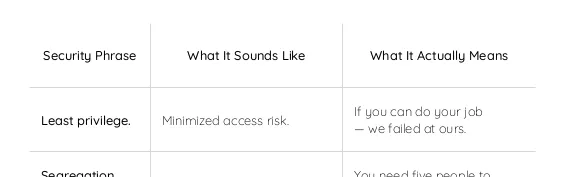 3.18 | SECURITY DEPARTMENT
ACCESS DENIAL AUTHORITY (screen from the book, page 190)
3.18 | SECURITY DEPARTMENT
ACCESS DENIAL AUTHORITY (screen from the book, page 190)
It is perfectly secure because the company can no longer function. No data can be leaked if no data can be processed. Security wins. The company dies.
Platform and the “Golden Path”
- Platform Engineering (or DevOps) optimizes for Maintainability and Standardization.
To achieve this, they build the “Golden Path”—a standardized, automated infrastructure ecosystem. However, local optimization can quickly turn this Golden Path into an architectural labyrinth. What should have been a simple, two-line code change to deploy a minor feature suddenly requires a three-week journey of writing custom Terraform modules, configuring Kubernetes sidecars, and earning a figurative PhD in internal infrastructure. It’s highly standardized, brilliantly maintained, and completely paralyzes product velocity.
Innovation Teams
- Innovation/R&D optimizes for Experimentation Speed.
Their mantra is to “move fast and break things.” They want to try every shiny new framework, write unmaintainable proof-of-concepts, and hand them off. If allowed to optimize without friction, they will successfully build three hundred distinct, incompatible prototypes using fifteen different programming languages, leaving the core engineering team to deal with the resulting structural wreckage.
The Myth of the “Adults in the Room”
When organizations struggle with these internal conflicts, the executive reflex is to search for the “adults in the room.” Surely, if we just find a wise enough leader, they can tell us who is right. Is Security right, or is Product right? Is Platform right, or is Innovation right?
This search is a category error.
The question “Who is right?” is fundamentally broken, because the terrifying reality of corporate systems is that everyone is absolutely, undeniably right.
If you step back and look at each department’s local objective, you cannot logically invalidate a single one of them. Even when they are in direct, violent contradiction.
- Security must minimize risk. If they don’t, a single catastrophic breach could wipe out the company.
- Product must optimize for velocity. If they don’t, competitors will eat their market share and the company will slowly starve.
- Platform must enforce maintainability and standards. If they don’t, the codebase decays into a digital landfill that no one can work on.
None of these goals are foolish, misguided, or negotiable. If any one of these departments stops doing their job, the organization collapses. The conflict isn’t caused by personality clashes, a lack of communication, or poor cultural alignment. The conflict is the logical output of a set of goals that are all simultaneously correct, and simultaneously incompatible.
It is not a puzzle to be solved; it is a permanent tension to be managed.
Systems Don’t Care About Your Org Chart
One of the greatest delusions of corporate leadership is the belief that restructuring solves systemic problems. We draw new boxes, connect them with solid and dotted lines, and present the new PowerPoint slide with the triumphant air of a general who has just conquered a continent.
But systems are remarkably indifferent to your org chart.
A system does not know who reports to whom. It does not read your internal newsletters, it does not care about your cultural values, and it certainly does not care about your agile sprint ceremonies.
A system only understands:
- Information flows (who actually talks to whom).
- Incentives (what behaviors get people promoted, paid, or fired).
- Feedback loops (how quickly the consequences of an action find their way back to the actor).
- Delays and Constraints (the friction inherent in taking action).
If you change the org chart but leave the local incentives untouched, the emergent behavior of the system will remain exactly the same. The names on the slides will change, but the Nash Equilibrium will quietly reassert itself, laughing at your PowerPoint presentation.
The Real Job of Leadership
Which brings us to the grand finale. What is the actual job of leadership?
Most leaders spend their days acting like amateur therapists or frustrated traffic cops. They try to convince people to play nice, to collaborate, to “break down silos,” and to “think of the bigger picture.” They treat systemic failures as personal moral failings.
This is a monumental waste of energy.
You cannot solve a systemic game theory problem with a pep talk. If the rational move for an individual is to look out for their own silo at the expense of the company, they will do so every single time—no matter how many trust-building workshops you make them attend.
The real job of leadership is not to convince people to cooperate. It is to design systems where cooperation is the only rational strategy.
If your organization requires extraordinary people making extraordinary sacrifices just to function normally, you don’t have a culture problem.
You have a game design problem.
John Nash and A Beautiful Mind taught us that stable equilibria are a fundamental law of system dynamics. They exist everywhere. But as modern organizations prove to us every single day: stability and sanity are two entirely different concepts.
If you don’t design the game, the game will design you.
Hungry for more systemic absurdity? Check out the full IT Dictionary, where I brutally deconstruct the hidden agendas, tragic incentives, and beautifully stable nightmares of every group in the modern organization.