· Systems · 13 min read
Vision is the Only Scarce Resource: What We Actually Need to Protect
After dismantling the myth of originality for four episodes, it’s time for the punchline: creativity isn’t under threat. Our ability to distinguish a vision from its imitation is.
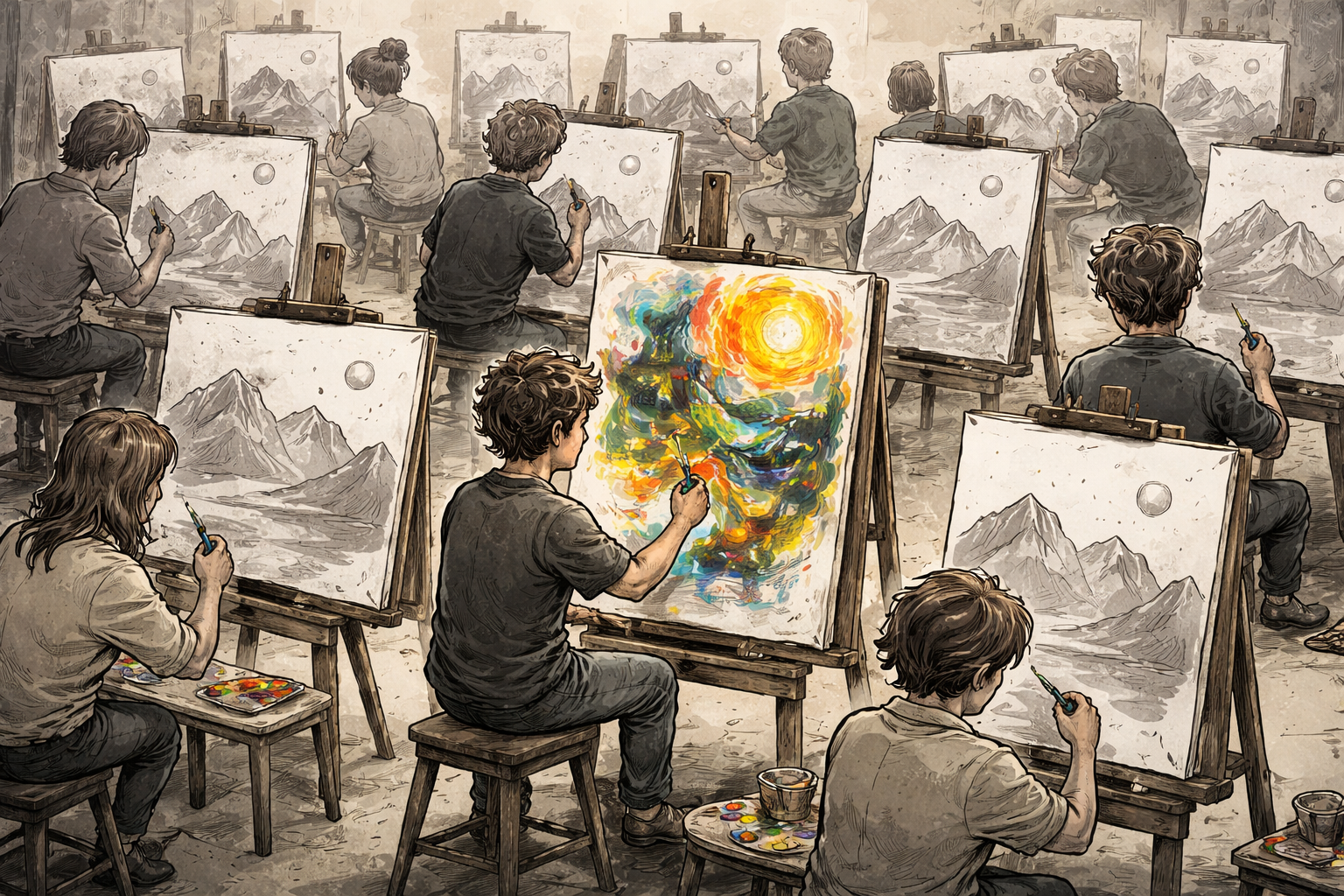
So, we’ve reached the end of the road.
If you’ve been following this series, you’ve seen me play the role of the digital party pooper. I’ve argued that your “divine” musical inspiration is just Pythagoras in a hoodie, that art history is just a very slow GPU benchmark, and that storytelling is a legacy library of thirty-one narrative functions we’ve been “npm installing” for millennia—even if Vladimir Propp only got around to publishing the documentation in 1928.
I’ve essentially spent the better part of a quarter taking the “soul” out of the machine and showing you the wiring. But before you start looking for my home address to throw rocks at my window, let’s talk about why this isn’t a funeral for creativity. It’s a promotion.
The “Expedition 33” Moment
Last year, a game called Clair Obscur: Expedition 33 appeared out of nowhere and essentially melted the internet’s collective brain. It looks like a multi-hundred-million-dollar blockbuster. Then the news broke: it was made by a relatively small team using 90% off-the-shelf Unreal Engine assets.
Those assets were available to absolutely everyone. You, me, and that guy who still thinks “Hello World” is a complex algorithm could have bought the exact same rocks, trees, and textures.
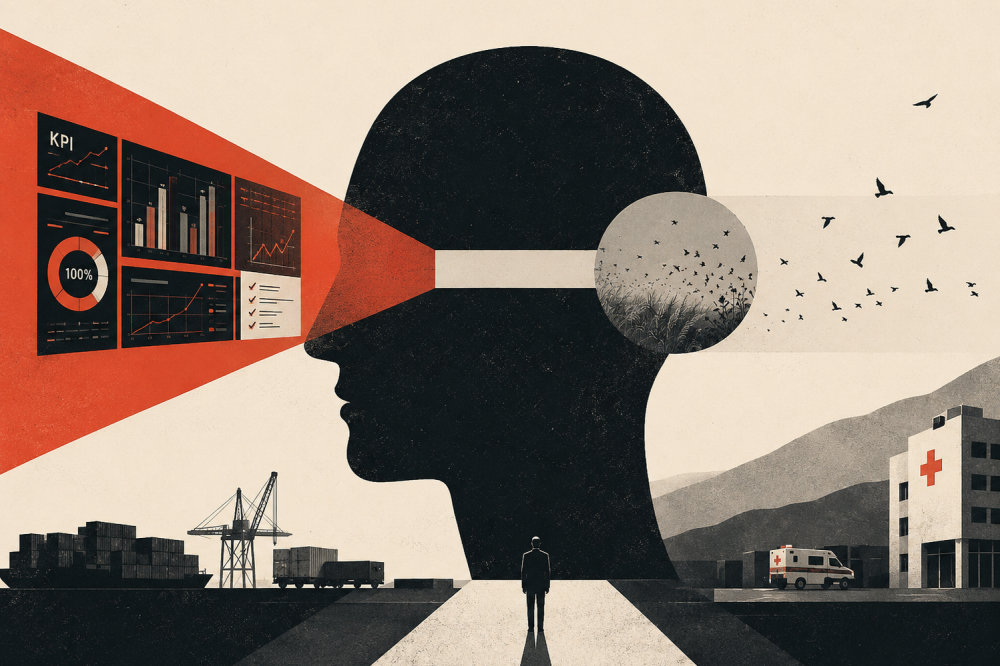
In the gaming industry, this usually leads to the “asset flip”—low-effort, generic slop that pollutes digital storefronts. But Expedition 33 felt like art because the developers had something no asset marketplace or subscription model can provide: vision. They didn’t spend ten years hand-sculpting every blade of grass; they used the library to build a world that looked like a 19th-century French painting came to life and started a fight. They didn’t innovate on the “how” (the rendering); they innovated on the “what” (the vision).
This is undeniable proof: when the tools are democratized, the “grind” loses its value. The vision becomes the only thing left worth talking about.
The Great Recap: Recombination is the Protocol
Let’s be honest about our history.
- The Monks: Didn’t invent data protection; they just made copying too expensive for the average peasant.
- The Mapmakers: Didn’t invent “originality”; they just booby-trapped facts.
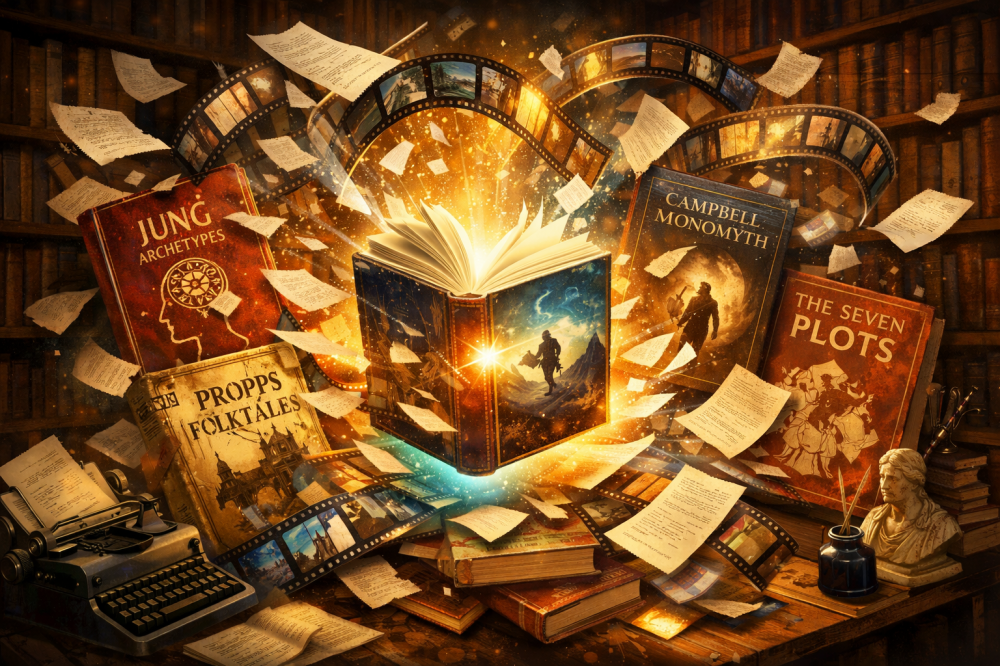
- The Writers: Between Jung and Campbell, we realized we’re just re-skinning the same Hero’s Journey for the ten-thousandth time.
- The Painters: From Pixel Art to Malevich, we’ve just been optimizing the “render” until the machine over.
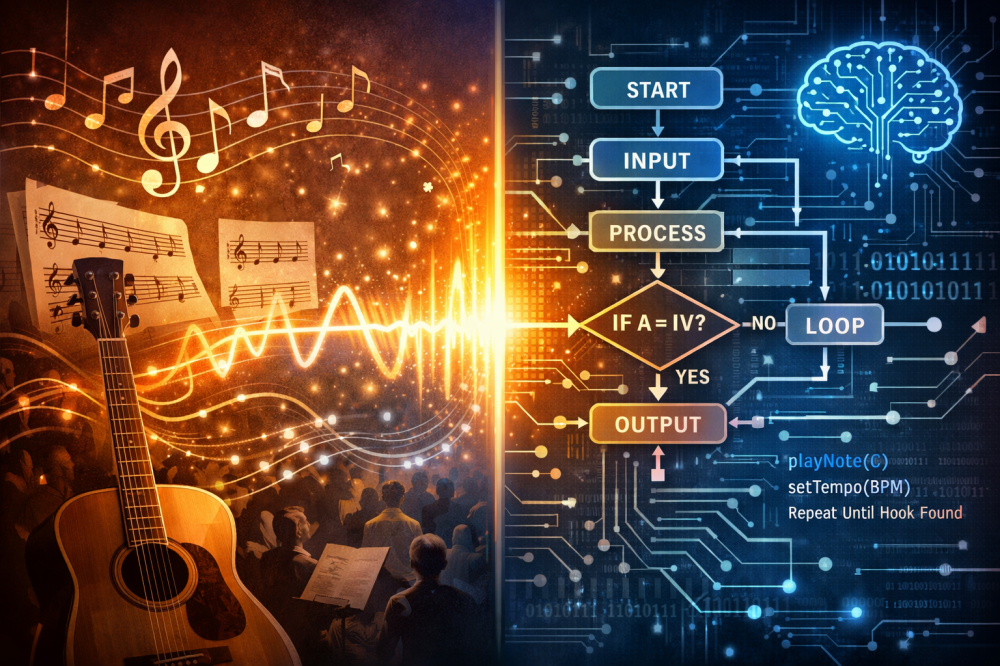
Recombination is not a bug in the human system. It is the protocol. We are all, at our core, high-end remixing engines. AI is just a mirror that’s finally showing us how we actually work, and we don’t like the reflection because it looks a bit too much like a spreadsheet.
The Democratization Alibi
When I was a kid, I was obsessed with fantasy and RPGs. I wanted to build my own world—not just a story, but a complete, breathing continent with its own lore. But I hit a wall. I didn’t have the literary craft to write down the history, and my drawing skills were so abysmal that I couldn’t even sketch a recognizable coastline. I spent years telling myself that if I only had the budget, I’d create a world that would make Tolkien say “holy shit” and Ed Greenwood (the father of Forgotten Realms) consider a career change. (Spoiler: Probably not, but we’ll never know.)
For that frustrated kid, AI isn’t a threat—it’s his “Geneva.” It’s the tool that finally allows the vision to bypass the lack of manual dexterity.
But here is the punchline we often ignore: having a high-resolution camera in your pocket for a decade hasn’t turned the world into a collective of award-winning photographers; it just gave us billions of high-def photos of avocado toast. Opening a Word document doesn’t suddenly download the narrative architecture of Stephen King, Terry Pratchett, or Tom Clancy into your skull. Installing GIMP or a Photoshop trial doesn’t magically grant you the eye of an artist.
We used to hide behind the “I can’t draw/code/write” alibi. That alibi is dead. Now, if you have a vision, you can see it on the screen in seconds. But this is where the irony sets in: most people realize they never actually had a vision. They just liked the idea of being an artist.
The Caricaturist with the Big Heads
You know that guy at the tourist pier who draws caricatures with massive heads? He has the “skill.” He can move the pen. He can render a face in three minutes. But he draws the same five faces for thirty years.
AI is the ultimate pier caricaturist. It has the skill, the speed, and the rendering power. But without a human providing the “soul” (the specific, weird, unique intent), it just produces more of the same, faster. It creates high-definition clichés.
The democratization of tools doesn’t devalue the vision; it removes the alibi for its absence. If you can’t make something interesting now, it’s not because you lack the “brushstroke”—it’s because you lack the “thought.”\
Ghostwriters, Editors, and the Authorial Gap
Before we judge the machine, we need to understand how the “factory” of creation actually works. In the writing world, there are three distinct scopes of responsibility. We often conflate them because a single person usually performs all three, but they are technically separate layers of the stack.
First, you have the Ghostwriter. This is the role of pure execution. Their job is the “how”—assembling competent, grammatically correct sentences that convey a set of facts or a plot point. They are the mechanics of language, grinding out the word count to fill the pages.
Then, you have the Editor. Their job is structural integrity and coherence. They ask the “what if” and the “does this hold together?” They ensure that a character’s motivation in chapter one doesn’t evaporate by chapter ten. They are the guardians of the narrative arc, looking at the work from 30,000 feet.
Finally, you have the Author. This is the source. The one with the Vision. The Author provides the “why.” They are the ones who decide that the story isn’t just about a dragon fighting Godzilla, but about that fight being a metaphor for industrial decay set in a 19th-century French bistro.
In reality, a human author often juggles all three. They have the vision, they act as their own first editor, and they do the heavy lifting of the writing. But as we move into the AI era, this stack is being forcibly decoupled.
Here’s the thing: AI is a world-class Ghostwriter. It is tireless, grammatically flawless, and utterly devoid of ego. It can generate ten thousand words of “text” while you’re still deciding what to have for lunch. If your only goal is to fill a page with competent prose, the machine has already won.
But when it comes to being an Editor, AI is catastrophic. It is a victim of what we call local optimization. It’s brilliant at making the next three sentences sound authoritative, but it has zero grasp of the global narrative arc. An AI editor will polish a paragraph into a diamond while completely missing the fact that the wheels fell off the plot three chapters ago. It doesn’t understand that a specific silence in the first act is the only thing that gives a scream in the third act its weight. It can emulate the texture of a story, but it cannot navigate the structure because it doesn’t actually understand why we care.
And the Author? The one with the vision? The machine isn’t even in the room. It has no “why.” It’s a car with a very shiny engine, but no driver and a GPS that only looks ten meters ahead.
The Craftsmanship Trap (Skill vs. Art)
This leads us to a necessary distinction: skill is craftsmanship. Vision is art.
And don’t get me wrong: I am not here to devalue craftsmanship. Anyone who has dedicated countless hours to achieving mastery in any field deserves immense respect. They should be celebrated, and they should certainly be paid.
But let’s stop confusing mastery with art. We don’t call exceptional carpenters, master chefs, or world-class accountants “artists” just because they are brilliant at their jobs. Why, then, are we so desperate to slap that label on anyone who can operate a trumpet or a mechanical keyboard?
Yes, there are chefs whose cooking reaches unreachable heights. There are carpenters whose chairs escape the very definition of “furniture.” But that doesn’t come solely from their technical skill—it comes from crossing a boundary that we instinctively recognize. They aren’t just following a recipe; they are imposing a vision upon reality. AI can replicate the skill, but it cannot jump the fence into that territory of instinctive intent.
Where is the Line? (Back to the Greeks)
To find where the line actually lies, we have to look back at Ancient Greece. They were far more honest about this than we are.
For the Greeks, techne (τέχνη) covered everything: pottery, sculpture, medicine, and mathematics. If it required knowledge and practice, it was techne. They didn’t have a separate, snobbish category for “high art.” Then Plato started messing with the order. In The Republic, he degraded artists not because they lacked skill, but because they produced mimesis—an imitation of reality, which was already just an imitation of Ideas. They were three steps away from the truth. The blacksmith making a useful sword was, in Plato’s eyes, far superior to the poet.
Aristotle, however, flipped the script by introducing poiesis (ποίηсις)—the act of bringing something into existence that wasn’t there before. This was the first seed of our modern distinction: techne is the reproduction of rules; poiesis is the introduction of novelty.
The Greeks were right to see this as a continuum rather than two separate categories. The problem only arises when our legal system needs to draw a hard line and, instead of looking at Aristotle’s poiesis, it reaches for the Romantic myth of the “divine spark.” We are trying to protect a “ghost” in the machine when we should be looking for the act of creation. As a criterion for legal protection, poiesis—the human choice to bring forth a new configuration—is paradoxically more precise than anything we have right now.
The Style Exchange Protocol (Innovation vs. Ownership)
There is one more elephant in the room: the debate over whether “copying” a unique style is theft. Many creators argue that because they spent years refining their signature look, they deserve a legal moat around it to keep others—especially machines—out.
I disagree—and I say this fully aware that for many of you, this is a deeply controversial, if not outright inflammatory, hill to die on. History teaches us that the free exchange of ideas is the primary catalyst for progress. Science is the gold standard here: Newton didn’t claim royalties every time someone used differential and integral calculus or gravity just because the math was hard. Copernicus and Galileo didn’t trademark heliocentrism as their personal “vision.” Higgs didn’t “close” the idea of the boson. The result? Science gained a massive, unhindered accelerator.
Economy tells a similar story: the exchange of ideas and goods leads to the growth of every society participating in that trade. The more barriers you build, the slower the growth. Closed systems stagnate, open systems accelerate.
Why should art be different? Especially when—as I’ve shown throughout this series—no creator works in a vacuum. Every “unique” style is just a high-level recombination of the ancestors’ work.
Does this create a problem for fair pay? Absolutely. The scientific community struggles with this exact same dilemma. I’m not claiming to have the solution. But I’m not going to pretend we can solve it by drawing a simple line and calling a style “proprietary property.”
The Respect of Understanding (or: Why the Black Square Matters)
Realizing that art is a form of recombination doesn’t devalue it. On the contrary. As a teenager, I was the first to mock certain artistic choices and frameworks. I can’t count the times I scoffed at Malevich’s Black Square, thinking it was just a lazy stunt anyone could pull off.
However, once I spent some time and energy understanding what lay beneath it, I gained respect. Sure, it’s still not something I’d hang in my living room (ignoring the fact that I can’t afford it), but I appreciated it.
It’s the same with every other field: being aware of the mechanisms and patterns doesn’t devalue the art or the craft. Louis Pasteur famously noted: “A little science distances you from God, but a lot of science brings you closer to Him.”
In the same vein, Richard Feynman argued that understanding the physics of a flower doesn’t diminish its beauty; it multiplies it. The scientist sees the same colors and shapes as the artist, but they also see the cellular complexity, the evolutionary struggle, and the subatomic dance. One doesn’t exclude the other—it adds to it.
They weren’t alone in this observation — it’s a pattern that repeats across disciplines, wherever someone looks long enough at how things actually work. Bohr, Gödel, Heisenberg, Einstein, and many others — the more you know about the ‘how,’ the more awe-inspiring the ‘what’ becomes. But this isn’t a collection of golden thoughts, so I’ll stop there.
A superficial observation of these mechanisms might suggest that art has no intrinsic value. But after reaching a deeper understanding, we gain respect for the humans who learned to navigate this dense web of rules and constraints to create something truly new.
The Ontological Crisis
Ultimately, we have to stop arguing about the surface and go back to ontology. We need to redefine our terms.
For the last three hundred years, we’ve built a house of cards called “Intellectual Property” based on the assumption that we are the only beings capable of poiesis. We defined “creation” by the human effort it required. Now that a server farm can mimic that effort in seconds, the definition collapses.
If we cannot define what a “creator” is in an era where the machine can replicate the output perfectly, we are just arguing about shadows on a wall. We have to ask: what is the fundamental nature of the object we are discussing? Is art the result, or is it the intent? If we don’t return to the core of what things actually are, we are going to keep litigating ghosts until there is nothing left to protect.
The Post-Mortem (Without the Fake Optimism)
The discourse is broken because we are asking the wrong questions.
Instead of asking “Is AI stealing?” we should be asking “How do we value vision when the execution is free?”
If anyone can generate a masterpiece in the style of a Dutch Master, the “masterpiece” is no longer a masterpiece. It’s just noise. The value migrates to the context, the curation, and the specific “weirdness” of the human behind the prompt.
We are entering an era where being a “craftsman” might not be enough to pay the bills, but being a “visionary” has never been more important. AI didn’t kill art; it just killed the excuse of “hard work” as a substitute for “good ideas.” We are forced back to basics, back to the fundamental definitions of being and doing.
The sacred keeps moving. We’ve automated the hand. We’ve automated the eye. We’ve automated the pattern. Now we’re left staring at the last thing the machine can’t replicate: the choice. The ontological core of our humanity.
Vision is the only scarce resource.
(This concludes The Copyright Dilemma series. If you’ve enjoyed these cynical ruminations, consider subscribing to the newsletter. I promise to move on to slightly more cheerful topics next week. Maybe. No promises.)